Get Full Government Meeting Transcripts, Videos, & Alerts Forever!
Get email alerts on the Infrastructure Constraints topic
No spam. Unsubscribe anytime.
Road, water and fire constraints surface as major limits to new housing
Summary
Presenters repeatedly flagged water availability, well-permitting rules and emergency-service capacity as gating constraints; Road & Bridge staff urged minimizing new driveway access points and the fire district will be consulted on taller buildings and mitigation needs.
As the SSR draft promotes denser or more varied housing types, staff and commissioners repeatedly cautioned that infrastructure limits—particularly water, wastewater, road access and fire protection—remain the principal constraints on whether zoning changes can produce new units.
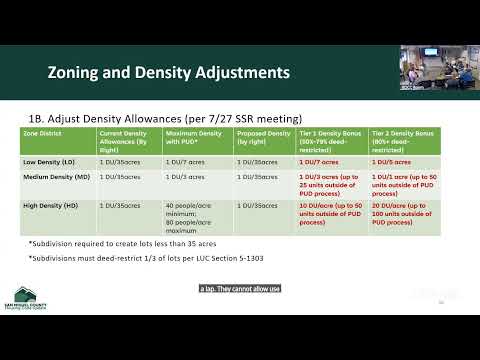
Kaye Simonson tied the 35-acre minimum to water permitting: "You simply cannot get a well permit for a new lot that's less than 35 acres," she said, explaining why smaller lot options depend on public water or subdivision arrangements. Ryan from Road & Bridge urged projects to minimize public-road conflict by sharing a single access point where feasible: "Our comments from Road and Bridge are always gonna be that we want to minimize those [driveways]." Simonson and commissioners agreed that all development applications will be referred to appropriate fire agencies and Road & Bridge during review; those referrals drive mitigation requirements (e.g., standpipes, hydrants) when needed.
Practical effect: Even with zoning changes, several participants warned that the county does not have large inventories of unsubdivided land and that water supply and topography will limit achievable yields. Staff suggested carrying-capacity studies and parcel-level analyses will be necessary to move from code changes to concrete projects.