Get Full Government Meeting Transcripts, Videos, & Alerts Forever!
Get email alerts on the Density Incentives topic
No spam. Unsubscribe anytime.
Commissioners review tiered density incentives tied to deed-restricted housing
Summary
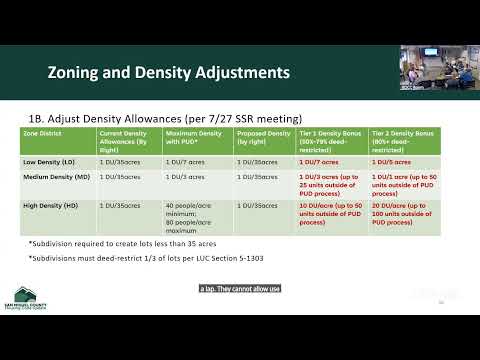
Staff proposed tier 1 and tier 2 incentives that raise deed-restriction targets and allow some projects to use faster 1- or 2-step review tracks; proposals include unit caps per tier and conversion formulas for mixed-use projects.
The SSR draft frames two incentive tiers designed to encourage deed-restricted affordable housing by offering faster review paths outside the PUD process. Under the current code, a developer must deed-restrict one-third (0.333) of lots or units; SSR members discussed tier thresholds where 50–79% deed restriction would be treated as tier 1 and 80%+ as tier 2, with corresponding density increases and caps to limit project scale.
Kaye Simonson explained the mechanics: "If they deed restrict 80% or more, they can increase the density to 1 dwelling unit per 1 acre up to 50 units outside of the PUD process" in a medium/high context, and she noted the intent is to let tiered projects proceed more quickly while imposing unit caps (for example, medium-density caps at 25–50 units depending on tier). Commissioners repeatedly returned to the arithmetic—units-per-acre versus acres-per-unit—asking how averages and minimum lot sizes interact in practice.
The discussion left several items unresolved: exact tier percentage thresholds to adopt in code text, whether the height bonus should apply to entire developments or only deed-restricted units, and how minor-subdivision rules (four-lot cap) interact with required deed-restricted lot fractions. Staff and SSR members said the technical tables will be updated and returned to SSR before being advanced to the planning commission.