Get Full Government Meeting Transcripts, Videos, & Alerts Forever!
Get email alerts on the Utilities Infrastructure topic
No spam. Unsubscribe anytime.
USDI study finds a railroad crossing main is a chokepoint; consultants recommend exploring new supply station
Summary
USDI presented a natural-gas network model calibrated to city data and identified a choke point where a 2-inch main crosses the railroad; USDI recommended studying a new higher-capacity feed station (Southern Star connection) as the most durable long-term fix and provided preliminary cost ranges for upgrades and new construction.
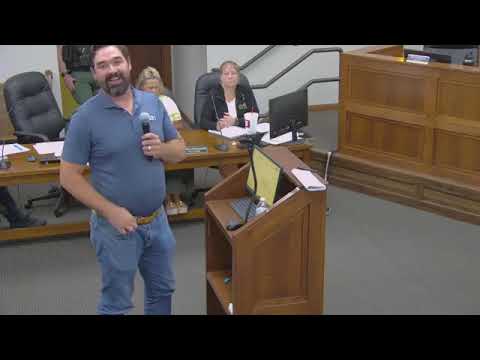
Tyler Lowey, a USDI engineer, presented the city’s natural-gas system model and said the model matched historical pressure data to within about 0.5 psi. The model focused on major industrial loads and projected five- and ten-year growth scenarios, including two hypothetical 300-house subdivisions and added industrial demand. Lowey said the study showed the system can meet current peak loads but that a choke point exists where a 2-inch steel main crosses the railroad, producing measurable pressure drops under higher loads.
Lowey summarized options for addressing the constraint: replace the 2-inch main at the railroad with a larger (6-inch) main; upgrade the existing regulator station and back-loop distribution; or establish a new higher-capacity feed point tied to the Southern Star line that would back-feed the system. He gave preliminary cost guidance: upgrading the existing station was described at about $1,250,000, a new station at about $1,550,000, and roughly $500,000 to connect the new station into the industrial park area; Lowey said the difference between upgrading and building new was approximately $300,000 in his estimate.
Lowey recommended the city consider a new feed station as the most durable solution to serve 20–40 years of growth rather than shorter-term station upgrades. Council members asked for an estimate sheet; council requested staff distribute the detailed estimate and follow up. After discussion, the council moved to receive and file the USDI gas-model report; that motion passed unanimously, 4–0.
Representative quote: "We were within, I think, 0.5 a PSI of what Thomas and them had actually seen in the system," Lowey said, describing model calibration. Lowey also told council: "There's about a $300,000 difference" between upgrading the existing station and building a new one, as a high-level budget comparison.
The study also noted federal-grant limitations: Lowey said typical federal programs prioritize cast-iron or otherwise identified at-risk pipe, and that those programs have not often funded upgrades to steel mains or station capacity, limiting immediate grant opportunities for the city. Council asked staff to provide the cost-estimate breakdown to the governing body for a future discussion on phasing and funding.