Get Full Government Meeting Transcripts, Videos, & Alerts Forever!
Get email alerts on the Mass Gathering Ordinance topic
No spam. Unsubscribe anytime.
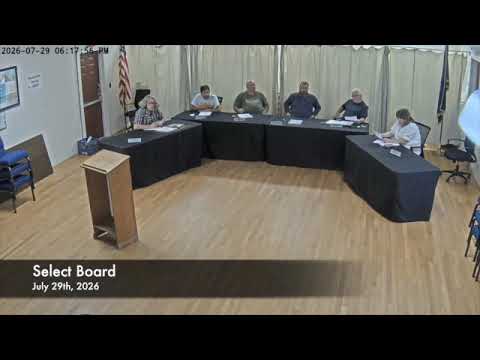
Select board debates rewritten mass-gathering ordinance, including thresholds, bonds and security requirements
Summary
Select board members and staff extensively revised a proposed mass-gathering ordinance, debating definitions and exemptions (including an explicit 'agricultural fair' carve-out), attendance thresholds (300+ attendees), permit lead time, insurance and a proposed $5,000 bond. Staff will draft permit procedures and bring a cleaned-up ordinance back next week.
The Select Board reviewed extensive revisions to a proposed mass-gathering ordinance and focused on who and what should be exempt and how permits should be triggered.
Staff explained the draft definition of a mass-gathering area and recommended explicitly exempting traditional agricultural fairs that the fairgrounds are equipped to handle. "So you're not calling out a particular type of property, like a fairgrounds," the Staff member said while recommending the phrase 'agricultural fair' be used to keep the exemption narrow. Board members discussed whether stadiums, arenas or other year-round venues should be treated differently or be subject to conditional-use review by the planning board.
Members debated permit thresholds and public-safety triggers. The board agreed to remove the earlier two-hour duration trigger and instead consider an absolute attendance threshold; several participants proposed 300 attendees as the point when a permit is required, while others suggested higher numbers for security considerations. "It says it's recognized that a mass gathering attended by 300 or more persons may create a hazard to public health and safety," Staff read from the draft.
The board also reviewed permit procedures and denial standards, including septic capacity, sanitation, trash management and prior violations. Members raised the possibility of requiring applicants to show proof of general-liability insurance naming the event location and discussed a proposed bond of no less than $5,000. Committee members questioned the bond's usefulness, with one saying, "I don't see where the bond helps the situation at all," while staff urged documenting insurance and an address on the certificate.
On security and traffic control, participants distinguished private security from law enforcement and proposed minimum staffing tied to attendance tiers (for example, two security officers per 500 attendees with additional personnel for each additional thousand). Staff said the fire chief and code enforcement will provide recommendations for traffic and safety needs and that a cleaned-up draft of the ordinance and permit procedures will be returned for further review.
Next steps: staff will produce a revised ordinance and a permit-procedures draft reflecting board direction on attendance thresholds, insurance, deposit/bond language and security/traffic minimums for consideration at the next meeting.