Get Full Government Meeting Transcripts, Videos, & Alerts Forever!
Get email alerts on the Derelict Vessels topic
No spam. Unsubscribe anytime.
Parish officials say grants and local funds will fund removal of roughly 57 derelict vessels
Summary
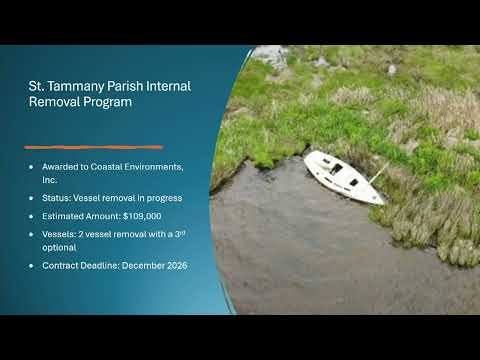
Consultants and parish staff told the Infrastructure Committee the parish’s $289,000 investment has leveraged roughly $3.1 million in outside grants to remove an estimated 57 abandoned or derelict vessels; permits and public‑notice steps mean removals may begin late August–September.
Ross Liner, St. Tammany Parish director of planning and development, and consultant Randy Sundy of Coastal Environments told the Infrastructure Committee the parish has leveraged modest local seed money into multiple outside grants to remove dozens of abandoned and derelict vessels from parish waterways. Sundy said the program has identified roughly 57 vessels tied to various grants and internal lists and that parish matching funds of about $289,000 have leveraged “a little more than $3.1 million” in grant funding.
Sundy described three principal grant streams: a NOAA‑related award that Sundy said provided about $900,000 (with a parish match of $150,000) to remove roughly 16 vessels, an NFWF award of about $225,000 for roughly five vessels, and additional approvals that would add barges and other targets. Sundy warned that permitting and public‑notice requirements are significant: “If I received [the permit] today, I wouldn’t be able to start pulling boats out until end of August, September,” he said, noting one funding line expires in December 2026 and another in December 2027.
Council members pressed on logistics and costs. Sundy said average per‑vessel costs can exceed $50,000 when environmental monitoring, hazardous‑material handling and disposal at a Class‑2 facility, certified divers, and cultural resource protections are required. He also described reconnaissance work that produced a parish database of about 100 targets. Liner and council members said local funding reduced wait times compared with relying solely on federal grants, but they agreed permitting and regulatory requirements can inflate removal costs and timelines.
The committee asked the administration to produce maps and lists showing which vessels fall in each council district, explain which grants fund which vessels, and outline timelines for permitting and removal. Sundy and Liner said they would deliver those materials and coordinate with coastal permitting staff about adding barges to existing permits where allowed. The presentation closed with the parish and consultants urging further work on prevention strategies and possible annual seed funding so the parish can leverage future grants more reliably.