Get Full Government Meeting Transcripts, Videos, & Alerts Forever!
Get email alerts on the City Hall Renovation topic
No spam. Unsubscribe anytime.
Council reviews $150,000 safety fix and $5 million renovation for City Hall capacity and accessibility
Summary
City staff presented a full renovation concept for City Hall with an estimated $5 million cost and a more modest $150,000 plan focused on front-counter safety, three private offices and audio/visual upgrades; staff said an RFI for A/V closes May 1 and an RFP could be issued late spring with possible summer implementation for the smaller package.
City staff laid out two paths for addressing long‑standing capacity and accessibility problems at Sandy City Hall: a full re‑envisioning priced in the millions and a targeted, lower‑cost package intended to fix immediate safety and workspace shortfalls.
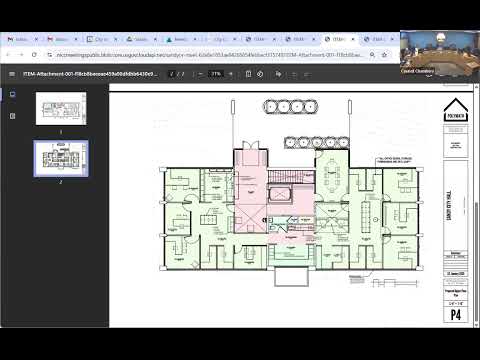
Tyler, a staff presenter, told the council the full renovation — which would reorient the council dais, add a proper elevator, upgrade HVAC and electrical systems and create additional private offices — had been costed at roughly $5,000,000. Jeff, who led the conceptual walk‑through, said the full remodel would deliver better sight lines in the council chamber and “private office space … so that you can shut your door and work on your quiet task.” He added such a project would trigger significant ADA requirements and a major construction program.
Because that price tag is “a heck of a lot of money,” staff also showed a more modest plan (exhibit C) that was recently put to bid. That option, Jeff said, would cost about $150,000, and include front‑counter protective glass, reorientation of existing workstations to yield roughly three additional workspaces, and construction of three private offices with walls to the ceiling for HR and city administration. He said the design also contemplates mini‑split HVAC to avoid replacing the full system. “This is a relatively inexpensive project that gets us some of those immediate capacity and safety issues resolved now,” Jeff said.
Council members asked practical questions about how many new offices the two options would create, whether planters or simple barriers could be used to funnel the public to a single entry, and whether FEMA or other grants for critical infrastructure could help pay for structural reinforcement. Tyler said the A/V work is being pursued separately: staff issued a request for information (RFI) that closes May 1 and plans to use responses to draft an RFP, aiming to bring a package back to council in late spring or early summer. If the council approves, Tyler said a contract for the $150,000 safety/capacity package could be in place in time for construction this summer.
Staff emphasized that the lower‑cost option is not structural (it relies on interior reconfiguration rather than altering building footprint) but does include security upgrades for front counter staff and some improvements that will be needed for better remote meeting and hearing access. Several council members urged staff to explore available grant opportunities while others noted the trade‑off between immediate fixes and the long‑term benefits of a full renovation. The council did not vote on funding at the session; staff will return with formal contract documents if the council wants to proceed.