Get Full Government Meeting Transcripts, Videos, & Alerts Forever!
Get email alerts on the Foreign Land Ownership topic
No spam. Unsubscribe anytime.
FFA forum in Sheridan County examines foreign ownership of U.S. farmland
Summary
Students and invited experts at an FFA forum in Sheridan County presented research on foreign-held U.S. agricultural land, weighing economic investment benefits against farmer displacement, national-security concerns and environmental risks. Panelists cited data and local recording challenges.
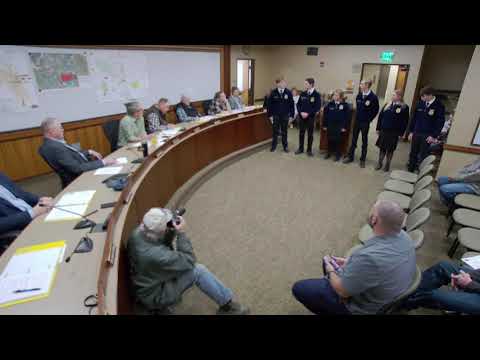
An FFA forum presented to the Sheridan County Board of Commissioners on March 3 examined the rise and implications of foreign ownership of U.S. agricultural land. The panel — introduced by Clay Christensen, FFA advisor — included an economist who highlighted investment benefits, a farmer who described local market pressures, a national-security analyst and environmental experts who outlined ecological tradeoffs.
"Foreign investment behaves like fertilizer. When used well, it makes everything grow," said Dr. Schroeder, an economist who cited U.S. holdings and examples of renewable-energy and infrastructure projects tied to foreign capital. Panelists and students noted USDA and American Farm Bureau figures that place foreign-held farmland at roughly 45,000,000 acres (about 3.6% of privately held farmland), with recent-year changes in the millions of acres.
Farmers and county officials pressed the panel on real-world effects. A local farmer described buyers paying well above local market value and said that higher prices make it harder for younger and smaller farmers to compete. "When foreign investors enter the market, they can pay well above local market value," a farmer told the panel. The national-security witness, Mr. Ludekaus, said security concerns depend on location as well as ownership — ‘‘20 acres next to a military base is far more threatening than 20,000 acres in the middle of the plains,’’ he said — and recommended faster reporting and real-time monitoring of land transactions.
Panelists also discussed environmental outcomes: Professor Lucy Linden and Kaya Castor said foreign-funded projects have supported reforestation and methane-reduction technology in some regions, but large-scale monoculture and heavy groundwater pumping can harm biodiversity and water resources. County Clerk Cliff Thompson described practical challenges for local governments in identifying buyers when purchases occur under virtual offices or LLCs, an issue the panel said will require further research and coordination with state and federal reporting systems.
The forum did not propose a single solution; speakers suggested targeted state-level restrictions (for strategic sites), stronger reporting and community-benefit agreements as policy tools. The moderator said the goal was to illuminate tradeoffs rather than endorse a blanket approach.