Get Full Government Meeting Transcripts, Videos, & Alerts Forever!
Get email alerts on the Opcd Phase 3 topic
No spam. Unsubscribe anytime.
OPCD outlines anti-displacement toolbox, Phase 3 zoning options and draft SEIS timeline
Summary
The Office of Planning and Community Development told the select committee it has a multi-pronged anti‑displacement toolbox—data dashboards, tenant protections, land banking and targeted incentives—and previewed Phase 3 zoning alternatives with a draft Supplemental EIS expected in early 2027.
The Office of Planning and Community Development presented a detailed anti‑displacement framework to the Select Committee on the Comprehensive Plan on July 30, describing both zoning and non‑zoning measures staff say will inform Phase 3 of the city’s planning work.
OPCD Director Fricko Kiddingongo and staff described a displacement risk dashboard, an anti‑displacement action plan and more than two dozen tools they intend to use, including tenant support and relocation assistance programs, homeowner tax relief and preservation funding. "We are assembling a body of data that tells us where in the city displacement risk is highest," said Michael Hubner, long‑range planning manager.
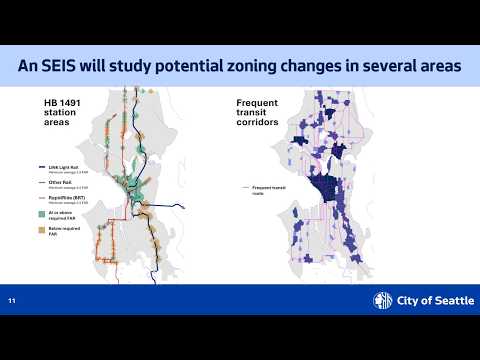
Jeff Wendland, OPCD land use policy manager, outlined Phase 3 zoning themes: expanding housing in growth centers and near parks and schools, evaluating HB 1491 (state TOD requirements) station‑area maps, and testing alternatives that would limit upzoning in high‑risk displacement areas. Wendland said one alternative will “hold down or moderate or not propose zoning changes in areas of high displacement risk” to give the council clear choices.
The department said a draft Supplemental Environmental Impact Statement (SEIS) that includes those alternatives is planned for release in the first part of 2027 and would prompt an extended round of public engagement. Kiddingongo said the city is coordinating with King County and other partners to ensure the plan emphasizes affordable housing at multiple income levels, and that staff are working to preserve funding levels for tools such as Mandatory Housing Affordability (MHA) while offering non‑zoning mitigation like land banking and community‑led development.
The presentation emphasized coordination: OPCD highlighted the Equitable Development Initiative and federal funding for equitable transit‑oriented development work, and said the city is cataloguing properties it controls (including parcels tied to Sound Transit) that could be reused for community‑led projects. "One way we can look to land bank is to better coordinate across different departments," Wendland said.
The committee asked detailed follow‑up questions about the scale of housing need (council members cited regional targets of roughly 112,000 new homes by the 2040s), how the SEIS will balance HB 1491 requirements with displacement concerns, and how the city will operationalize land‑banking and community‑led development. OPCD said those tradeoffs and mitigation menus will be described in the SEIS and accompanying materials.