Get Full Government Meeting Transcripts, Videos, & Alerts Forever!
Get email alerts on the Transportation topic
No spam. Unsubscribe anytime.
Draft traffic-calming policy proposes petition threshold and toolkit; resident warns against cameras
Summary
County staff presented a draft traffic-calming policy calling for a speed study and a 75% petition threshold within platted subdivisions before engineering; a resident asked whether the policy is a 'stealth' attempt to introduce surveillance or speed-detection cameras, which staff denied.
Justin, county staff, presented a draft traffic-calming policy that outlines a formal request process: conduct a speed study (staff uses the 85th percentile to identify speeding), require a petition signed by 75% of lots in the platted subdivision before proceeding with engineering, and evaluate toolbox options ranging from low-cost optical treatments to more substantial devices such as chicanes or small roundabouts. Justin said vertical traffic-calming measures are generally disfavored because of hydrology and safety concerns and noted any approved measures would need to meet GDOT standards if within the right of way.
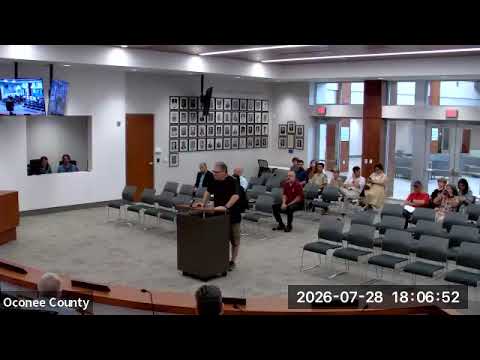
During public comment resident Steven Elshara asked whether the policy was "a stealth attempt to get flock cameras or something equivalent like axon cameras around or other electronic means," and the chair responded that the policy "has nothing to do with flock cameras" and that enforcement and camera deployment are the sheriff's office responsibility. Commissioners sought clarification about how the 75% petition threshold applies when a subdivision has no homeowners association; Justin clarified the 75% requirement applies to aggregate lots of record in the platted subdivision, not solely to HOA membership.
Justin said costs for approved measures would generally be borne by homeowners or an HOA unless the county's budget allows otherwise and that, where feasible, the county could create a special tax district similar to a streetlight district to finance installation and maintenance.