Get Full Government Meeting Transcripts, Videos, & Alerts Forever!
Get email alerts on the Affordable Housing topic
No spam. Unsubscribe anytime.
Consultants point to Charlottesvilles sensitive-area approach as model to limit displacement
Summary
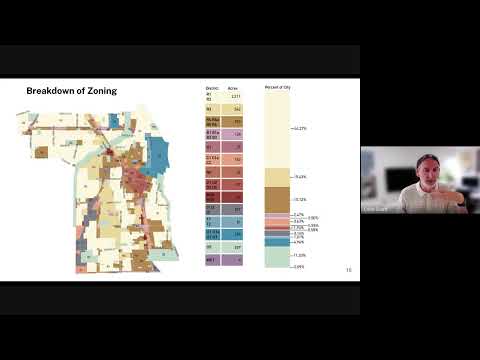
A Code Studio partner described a Charlottesville case study that created a special RA district to reduce displacement risk: allowed up to three units on many lots and up to six units if units are affordable at 80% AMI, used as an equity tool to retain residents while enabling modest infill.
Lee, introduced by Colin Scaff as a Code Studio cofounder, described a Charlottesville project the team crafted to protect disadvantaged neighborhoods from displacement. He said the approach created a special district that reallocated residential lots into an "RA" district allowing up to three units on many lots while preserving existing structures and enabling additional units in rear or side additions; the district also allowed up to six units on a lot where units are income-restricted at 80% of area median income.
"And then if the units are actually affordable at 80 percent AMI, which is an enormous challenge, we are told that the math of this works," Lee said, explaining that the combination of retained main units and added accessory units can make infill financially feasible while aiming to keep existing residents in place. He said the district was designed after detailed feasibility and cost analysis to quantify risk of displacement and to allow limited new units without wholesale demolition.
Lee framed the Charlottesville example as a transferable approach for Evanston where the team would evaluate parcel-scale capacity, identify "sensitive areas" and tailor district rules so that new units can be added without pushing out existing households. He emphasized the need for data-driven affordability strategies and local partners to implement such targeted tools.