Get Full Government Meeting Transcripts, Videos, & Alerts Forever!
Get email alerts on the State Density Bonus topic
No spam. Unsubscribe anytime.
Planners explain how the state density bonus affects local design standards
Summary
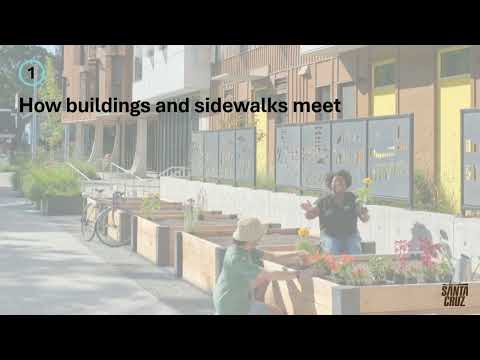
Staff explained that the state density bonus allows deviations from local objective standards—height, setbacks and facade rules—so Santa Cruz is developing voluntary design guidelines to signal community expectations to developers early in design.
Senior planner Akana Jayawadna told attendees that state law and the state density bonus are central reasons for producing voluntary design guidelines. "Most housing development projects in Santa Cruz utilize the state density bonus," Jayawadna said, and that use allows projects to deviate from height limits, setback requirements and some architectural standards.
Community Development Director Lee Butler amplified that point, saying the city's inclusionary ordinance and the density bonus have driven larger-scale redevelopment. "I would expect the developers start with [the] 'how much' question," Butler said, describing how developers calculate maximum units and then consider design after that initial sizing. Butler said many projects pursue the full density bonus, producing six- to eight-story buildings in downtown and corridor locations.
Staff and commissioners discussed incentives used in past planning efforts (for example, downtown density-bonus approaches that tied incentives to maintaining an 85-foot height limit) and said similar levers could be considered later to encourage compliance with desired design characteristics.