Get Full Government Meeting Transcripts, Videos, & Alerts Forever!
Get email alerts on the Water Planning topic
No spam. Unsubscribe anytime.
Board adopts 2025 Urban Water Management Plan and Water Shortage Contingency Plan amid questions about WRF capacity
Summary
The board adopted the 2025 UWMP (Resolution 23‑2026) and the 2025 Water Shortage Contingency Plan (Resolution 22‑2026). The UWMP includes a 150 acre‑foot WRF annual supply assumption; public commenters urged testing of WRF pumping rates and adding disclaimers about unfinalized permits and unverified pumping rates.
The Cambria Community Services District board on May 14 adopted two key water planning documents: the 2025 Water Shortage Contingency Plan (WSCP) by Resolution 22‑2026 and the 2025 Urban Water Management Plan (UWMP) by Resolution 23‑2026.
Staff and consultant presentations explained the updates: the WSCP aligns with California Department of Water Resources guidance and provides a staging framework for shortages under California Water Code section 10632. Staff emphasized the plan's flexibility — additional demand‑reduction or supply‑augmentation measures may be invoked by separate resolution during a declared shortage. The board adopted the WSCP after discussion of drought metrics and triggers.
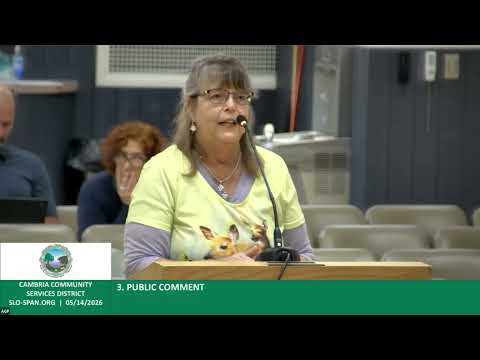
The UWMP presentation described system characteristics, projected demand to 2050, and supply planning. Staff and consultant explained that the UWMP includes recycled water uses and assumed the water reclamation facility (WRF) could provide about 150 acre‑feet annually as a conservative operational assumption rather than continuous maximum output. Board members and the public pressed staff on assumptions: Director Gray and others asked about recycled water feasibility and whether the plan overestimates available reuse without major capital projects. Public commenters (Crosby and Laura Swartz, among others) urged the district to test WRF pumping rates (citing a Todd groundwater memorandum suggesting effective pumping ranges of 200–300 gallons per minute) and requested a disclaimer noting that WRF permit conditions and most effective pumping rates have not yet been verified.
Consultant and staff responded that the UWMP is a scenario‑based planning tool required every five years, intended to show what supply would look like if certain growth or supply actions occur, not to compel action. After public comment and board discussion, the board moved and adopted the UWMP and the WSCP; roll call votes were unanimous.
Key immediate follow‑ups include continued WRF permitting work with the Coastal Commission and further technical testing recommended by commenters.