Get email alerts on the Housing Study topic
No spam. Unsubscribe anytime.
Planners present Urbana housing needs study methodology, flag census discrepancies
Summary
Champaign County RPC and city planning staff introduced the Urbana Housing Needs Study, focusing on data gathering, the October 2024 special census that reclaimed roughly 2,400 residents, divergence from ACS estimates, and outreach plans; council asked for deeper breakdowns by income, unit size, and outreach to vulnerable populations.
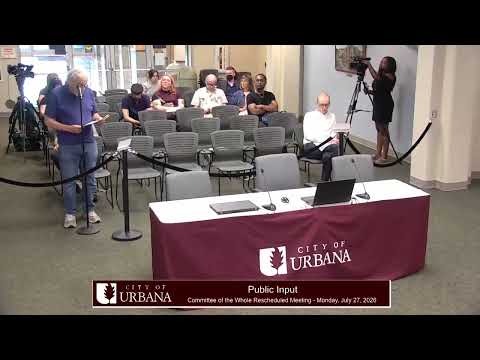
City planning staff and the Champaign County Regional Planning Commission introduced the Urbana Housing Needs Study at the Committee of the Whole, emphasizing data methods and the role of a special census conducted in October 2024.
Planner JD McClanahan explained that the special census data published in February 2025 identified more than 2,400 additional people in studied blocks compared with the 2020 decennial census. The presentation noted discrepancies between university enrollment figures, ACS estimates and the decennial census and described a methodology that uses USPS unit counts, landlord registry data, stakeholder interviews and a resident survey (325 responses) to supplement federal datasets.
Council members pressed for more granular rent data and for the study to incorporate the city's rental-registration database to generate a distribution of rents by unit size and $100 increments — a request repeatedly urged by resident speaker Esther Pat. JD said the landlord survey returned 134 responses and that staff will present existing-conditions findings at the next meeting; staff also committed to developing targeted outreach to renters, voucher holders, seniors and people in nontraditional housing arrangements.
The RPC presentation highlighted divergence in vacancy estimates (ACS near 10% vs landlord-survey-derived 1.3–5.5%) and explained the team's approach to reconcile differences by applying manual quality assurance, alternative local datasets, and sensitivity ranges for projections.
AI generated
The text on this page is AI generated. Summaries, highlights, analysis, and video transcripts are all produced from the original source material.
AI can make mistakes, so if you spot one, and we will fix it for everyone.
Note: the source content is unaltered by us. Any content source we link to, be it a video, an audio recording, or a document, is presented exactly as its publisher released it. That publisher is usually a government body, sometimes an individual official or another organisation.