Get Full Government Meeting Transcripts, Videos, & Alerts Forever!
Get email alerts on the House Bill 2138 topic
No spam. Unsubscribe anytime.
Planning commission hears staff plan to comply with Oregon's middle-housing law
Summary
City staff told the Lake Oswego Planning Commission how it will implement House Bill 2138, including immediate annual-code amendments by Jan. 1, 2027, and later rulemaking work by Jan. 1, 2028; staff emphasized a two-step compliance approach and potential incentives for accessible and affordable units.
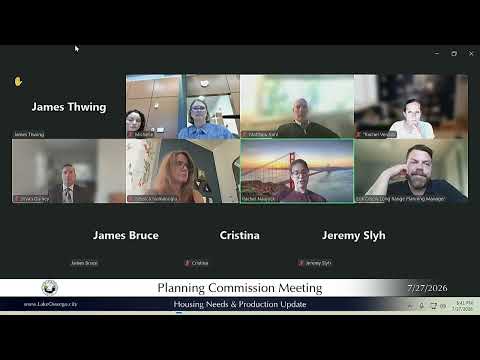
The Lake Oswego Planning Commission on July 27 received a staff briefing on Oregon House Bill 2138, the 2025 middle-housing law, and how the city plans to comply with the law's near-term and longer-term deadlines.
Eric Olson, the city's long-range planning manager, told commissioners the city plans a two-step approach: adopt limited annual code amendments this year to meet the January 1, 2027 compliance deadline and fold remaining changes into a broader code-audit project to align with state rulemaking taking effect by January 1, 2028. "We are proposing just to implement the state statute," Olson said, noting that the state will provide further rulemaking detail for some items.
Olson summarized required changes the law brings to middle-housing definitions and allowances: duplexes, triplexes and quadplexes must be allowed in areas where single-family housing is currently permitted; cottage clusters and new "detached plex" configurations will be subject to revised definitions and design standards. He also flagged programmatic elements such as density bonuses tied to accessible or affordable units.
Commissioners asked about likely market responses and whether developers are already designing to the new allowances. Olson said the city has seen relatively few middle-housing projects since the 2022 adoption of middle-housing allowances, but that flexibility and bonuses in the new law could change development economics. He emphasized that much of the detailed design guidance will come from forthcoming state rules.
The commission scheduled a public hearing on its 2026 annual code amendments (which will include the changes needed to allow detached configurations) for Sept. 14.