Get Full Government Meeting Transcripts, Videos, & Alerts Forever!
Get email alerts on the Scheduling And Case Progress topic
No spam. Unsubscribe anytime.
Baltimore County Board of Appeals declines motion to reconsider scheduling order in Pikesville Hospitality case
Summary
The Baltimore County Board of Appeals rejected a motion to reconsider its scheduling order in case CBA 21017 (Pikesville Hospitality Investors) and confirmed the June 2, 2026 order and June 15 memorandum, scheduling an evidentiary hearing to proceed under existing deadlines.
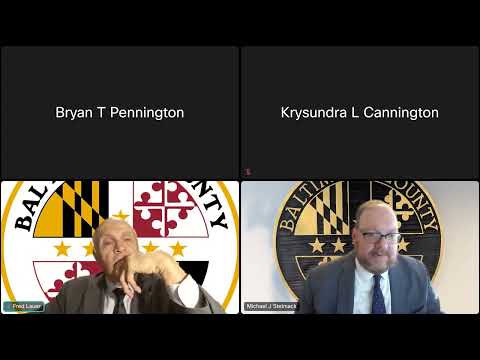
The Baltimore County Board of Appeals voted verbally to dismiss a motion to reconsider the panel's scheduling order in case CBA 21017, involving Pikesville Hospitality Investors. Chair opened the deliberation and framed the session as "a public deliberation on the motion to reconsider" arising after the Appellate Court of Maryland remanded the matter.
The chair told colleagues that the board's June 2 ruling, reflected in a June 15 memorandum, would remain in effect and that the board would "go ahead and, schedule our evidentiary hearing" under that order. Mister Pennington and Mister Thalmack both signaled agreement. The board reaffirmed that initial memoranda submitted in advance are intended to narrow issues and that the panel may request closing memoranda or additional briefing after the hearing if necessary.
The chair also emphasized limits on the board's powers around subpoenas, saying the board "can issue subpoenas, but cannot require persons to attend," and described how motions to quash and unresolved subpoenas would be handled as preliminary matters at the outset of the evidentiary hearing. The board did not change the 30-day and 15-day deadlines already set for subpoenas and motions to quash.
No formal roll-call vote appears in the transcript; the outcome was recorded by the chair's announcement and verbal assent from the other members. The board's action preserves the prior schedule and moves the case forward to a hearing stage where preliminary evidentiary motions will be addressed before any merits hearing.