Get Full Government Meeting Transcripts, Videos, & Alerts Forever!
Get email alerts on the Local Concerns topic
No spam. Unsubscribe anytime.
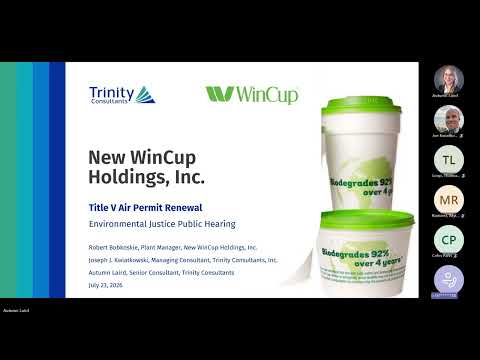
Residents press WindCup on formaldehyde levels and nearby stream, company says it will follow up
Summary
Local residents questioned whether modeled formaldehyde and other air toxics could reach nearby waterways and requested clarification about a stream and the adjacent Peter J. Barnes Wildlife Preserve; WindCup consultants said they would provide formal written responses and noted formaldehyde is a combustion byproduct modeled as an air emission.
At the hearing several residents raised site-specific concerns: Julio (resident and environmental commission member) asked why WindCup remains designated a major source, whether the company is investing in community composting education, and whether machinery would last the five-year permit term.
"So your potential to emit is above the threshold. And that's why you need this permit," a consultant explained, clarifying that New Jersey's major-source designation is based on potential-to-emit thresholds rather than current actual emissions.
Peter Ferrer Bluff, identifying himself as an alternate with the Barnes Commission, asked about a stream and wetlands immediately south of the property and whether the EJIS's one-mile assessment missed local water features. Bluff said the Dismal Swamp Preserve (now called the Peter J. Barnes Wildlife Preserve) borders part of the property and pressed for details on whether short-term formaldehyde spikes could affect water or wetlands. Consultants acknowledged the concern and said they would examine the record and provide a formal written reply.
Consultants also said modeling treats formaldehyde as an air emission from combustion sources (boilers) rather than a direct waterborne contaminant and that the permit documentation contains hourly and annual emission estimates that can be provided on request.