Get Full Government Meeting Transcripts, Videos, & Alerts Forever!
Get email alerts on the River Restoration topic
No spam. Unsubscribe anytime.
Woodstock riverbank project to reuse excavated material; grants and Army Corps permits discussed
Summary
An engineer outlined a bioengineering riverbank stabilization in Woodstock that will excavate and reuse on higher lifts to avoid raising flood elevations, funded largely by the state Clean Water Block Grant and a National Fish and Wildlife Foundation award; the board and public questioned permits, access and long-term maintenance.
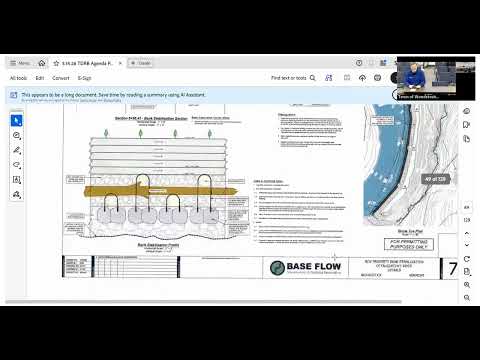
An engineer presenting the Woodstock riverbank stabilization project told the planning board the work will excavate material from the lower bank and place it higher so the project will not increase flood elevation. The presenter, who said he works at CRC, said the method avoids adding "fill" to the channel and that Army Corps permitting applies when a waterway is navigable; the Corps for Vermont, he said, operates out of an Essex Junction office.
The presenter described a mix of in-stream structures—root wads and logs—and a vegetated floodplain bench. He said planted material will sit principally in the 500‑year floodplain while some root wads will be visible at low water and underwater in a 100‑year event. He noted a 10‑year operation and maintenance agreement associated with state and USDA grant terms and said the project team will replant if stem survival drops below about 70%.
Funding and technical specifics were provided: the presenter said the Clean Water Block Grant program is providing more than half of a roughly $600,000 project allocation and that the National Fish and Wildlife Foundation is providing additional grant support focused on nitrogen‑reduction for Long Island Sound. He said the team plans approximately "400 stems per acre" and that the project will return for maintenance if necessary under grant conditions.
Board members and attendees asked about off‑site impacts and the potential for downstream or upstream erosion from soft‑armoring approaches. The presenter said the engineer designed the project to avoid creating new erosion hotspots and that, if unexpected erosion occurs, the maintenance agreement obligates the project team to return and repair the work. He also said Woodstock Associates owns much of the corridor where the work will occur, Sabrina granted access across her field for staging, and a cultural‑resource "hit" (old dug bunkers) was identified in the staging field.
The board asked staff to follow up on permit timing; the presenter noted the team paid a $2,500 application fee in April and that applicants should expect longer lead times when the Corps is involved. The board will consider the applications in a subsequent closed‑door session and vote.