Get Full Government Meeting Transcripts, Videos, & Alerts Forever!
Get email alerts on the Settlement Fund topic
No spam. Unsubscribe anytime.
Proposal would create Indian Water Rights Settlement Completion Fund with annual subaccounts for maintenance and new settlements
Summary
S 48 90 would establish mandatory subaccounts in an Indian Water Rights Settlement Completion Fund, providing $45 million annually for operation and maintenance of enacted settlements and $250 million annually for newly enacted and continuing settlements, with an offset proposed via customs user-fee extensions.
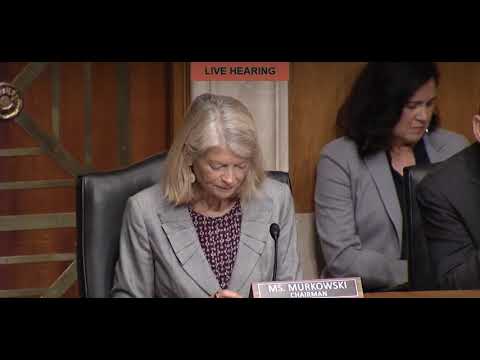
Chair Murkowski described S 48 90 from Senator Lujan as a proposal to establish mandatory subaccounts within an Indian Water Rights Settlement Completion Fund created by the bipartisan infrastructure law. One subaccount would provide $45,000,000 annually for operation, maintenance, repair and other continuing federal obligations under specified enacted settlements; the other would provide $250,000,000 annually for newly enacted and continuing settlements.
"S 48 90 ... 1 would provide $45,000,000 annual for annually for operation, maintenance, repair, and other continuing federal obligations under specified enacted settlements. The other would provide 250,000,000 annually for newly enacted and continuing settlements," Chair Murkowski stated in opening remarks. She asked whether that approach could provide a durable bipartisan solution in today's fiscal environment.
Chair Murkowski also noted a related proposal to offset the fund by extending customs user fees, invoking the 2010 Claims Resolution Act precedent where customs-fee extensions were used as a budgetary offset. Vice Chair Schatz stressed the need for a stable funding source to convert legal settlements into delivered water and warned that prior Infrastructure Law funds are exhausted.
The opening statements set the policy trade-off for the hearing: crafting a durable, politically viable funding mechanism that fulfills trust responsibilities without creating unsustainable fiscal obligations.