Get Full Government Meeting Transcripts, Videos, & Alerts Forever!
Get email alerts on the Native Children Bill topic
No spam. Unsubscribe anytime.
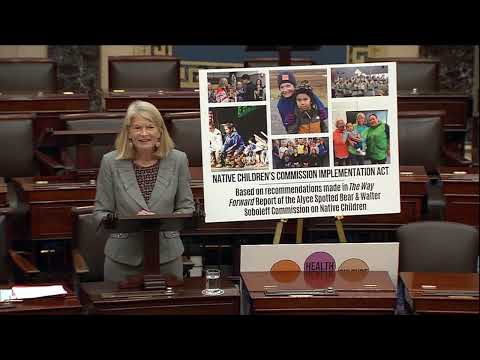
Chairman of Senate Indian Affairs Committee introduces Native Children's Commission Implementation Act
Summary
The chairman of the Senate Committee on Indian Affairs delivered a floor statement introducing the Native Children's Commission Implementation Act, urging colleagues to cosponsor and describing provisions to bolster health, education, juvenile justice, housing and cultural supports for Native children.
The chairman of the Senate Committee on Indian Affairs used a Senate-floor statement to introduce the Native Children's Commission Implementation Act, describing it as legislation born from years of work with tribal leaders, youth and advocates. He asked colleagues of both parties to join Senators Schatz and Smith as cosponsors and framed the bill as a continuation of a movement rooted in tribal communities.
The chairman said the measure seeks to turn the Alice Spotted Bear and Walter Sobolev Commission's recommendations — a report he called "The Way Forward" — into law to improve outcomes for Native children. "This bill is stronger because it was built with native communities, not for them," he said, adding that the legislation would not create a new federal program but would instead strengthen what is already working in Native communities.
He outlined the bill's cross-cutting approach, saying it would strengthen access to health and behavioral health services, support Native education and language revitalization, and address juvenile justice, housing, nutrition, workforce development and research. The chairman repeatedly emphasized tribal leadership and local solutions: the bill, he said, recognizes tribal governments "are best positioned to lead these efforts because they know their children and their families."
The chairman recounted testimony presented to the committee and related staff briefings — including stories from tribal elders, youth and families — as the impetus for legislative action. He concluded by asking colleagues to "show that when tribal communities speak, Congress listens" and yielded the floor.