Get Full Government Meeting Transcripts, Videos, & Alerts Forever!
Get email alerts on the Arts And Culture topic
No spam. Unsubscribe anytime.
Historic board declines to recommend mural/sculpture ordinance; asks for clearer definitions and residential exemptions
Summary
The board reviewed Ordinance 2026-02 to allow murals and sculptures attached to structures, raised concerns about definitions, residential permitting and visibility, and voted to not recommend the ordinance to the City Commission while requesting clarified language and exemptions for single‑family homes.
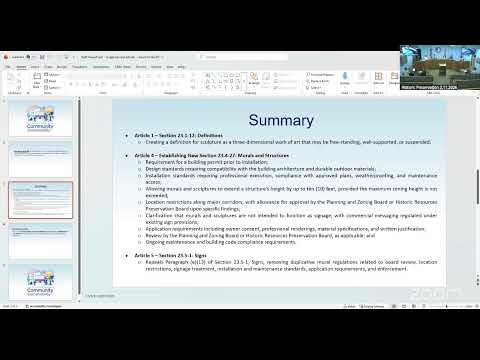
The Historic Resources Preservation Board reviewed a draft LDR amendment (Ordinance 2026-02) to allow murals and sculptures attached to structures and decided to not recommend the ordinance to the City Commission pending revisions. Lauren Prost, principal planner, summarized the draft and said it creates a definition for sculpture, sets installation and maintenance standards, requires building permits, and allows murals and structures to extend a building’s apparent height by up to 10 feet if zoning height is not exceeded.
"The proposed ordinance creates a definition for sculpture as a three‑dimensional work of art that may be freestanding, wall supported, or suspended," Prost said in the presentation. Board members raised a series of concerns: how enforcement will work, whether distance or anti‑concentration rules are needed, whether murals visible from major thoroughfares should be treated differently, and whether single‑family residential properties should face the same permitting burden as commercial or multi‑family buildings.
Members repeatedly asked for a clearer definition of "mural" vs. "graphic design" and sought explicit guidance about when a mural on a residential property would require a permit. One staff speaker noted that murals are currently permitted only in commercial and industrial districts under existing code provisions but that the draft would expand where murals could be allowed while relying on other design guidelines in major corridors and historic districts.
After discussion, the board voted to not recommend the ordinance as drafted and asked staff to return to the City Commission with clarified definitions, language exempting or easing requirements for single‑family residences (or limiting review to street‑facing/visible installations), and guidance about overconcentration and durability standards. Lauren Prost said she would carry those clarifications forward to the commission.