Get Full Government Meeting Transcripts, Videos, & Alerts Forever!
Get email alerts on the Family Communication topic
No spam. Unsubscribe anytime.
Training models family conversations: scenarios to guide educators' communications
Summary
LDOE used three family scenarios (kindergarten, second grade, older students) to model how educators should respond to parent concerns, affirm questions, and use handbook sections and sample language to support conversations about screening and next steps.
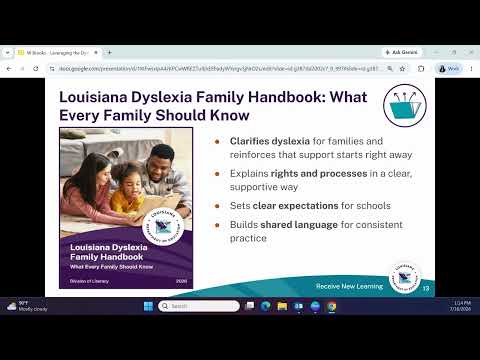
During the session, Wendy Brooks walked participants through three family scenarios to demonstrate how to use the handbook in conversations. In a kindergarten example she suggested educators "affirm the parents' concerns" and use the "what is dyslexia" section and the early signs chart to guide families through initial steps and classroom observations.
For a second-grade scenario Brooks advised educators to explain that an "at risk" screening result does not mean dyslexia is confirmed but signals a need to gather more targeted skill measures. For older students she encouraged teams to review data, consider accommodations and assistive technology, and point families to handbook sections on supports for middle and high school students.