Get Full Government Meeting Transcripts, Videos, & Alerts Forever!
Get email alerts on the Budget Cip topic
No spam. Unsubscribe anytime.
Smithville staff outline $70M five-year CIP and warn funds will need outside financing
Summary
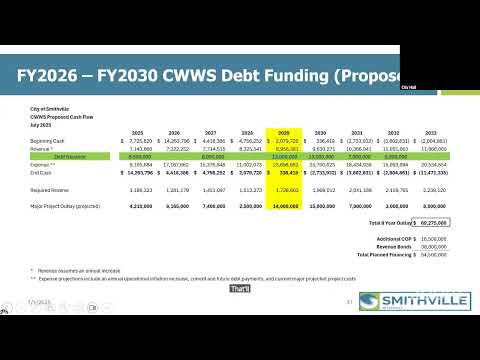
City staff presented a five-year capital improvement program totaling roughly $66–70 million and told the board rising construction costs and project timing could push several funds below required reserves, prompting consideration of external financing and tighter prioritization.
City finance staff told the Smithville Board of Aldermen that the city’s five‑year capital improvement program (CIP) now totals roughly $66,000,000–$70,000,000 and that reimbursements and grant timing will determine how much the city must cover out of local funds. "We have total of just over 66,000,000 in those 5 years," Rick said as he walked the board through the projections.
Rick highlighted reimbursements tied to many projects and said the city currently shows "the reimbursements are just over $6,000,000," with total project estimates near $15,000,000 on that subset — leaving roughly $8,000,000 in local exposure for those listed projects. Staff warned that several large projects have had cost increases and that projects routinely spill across fiscal years, which reduces short‑term fund flexibility.
Because much of the five‑year spending is concentrated in the combined water and wastewater fund, staff said the city is likely to need external financing to deliver the full program. "There will be a need for external funding to get all of this accomplished," Rick said, adding that debt service implications and future rate impacts are unavoidable if the board approves the full scope as proposed.
The presentation included a plan for frequent staff updates; Rick said he, Chuck and finance staff will meet every other week to update numbers and highlight changes as they arise. The board did not take formal action on the CIP during the work session but directed staff to prepare alternatives, prioritize projects that capture reimbursements and consider phasing to avoid fund deficits.