Get Full Government Meeting Transcripts, Videos, & Alerts Forever!
Get email alerts on the Nomination topic
No spam. Unsubscribe anytime.
Senator urges opposition to Jay Clayton's nomination for director of National Intelligence
Summary
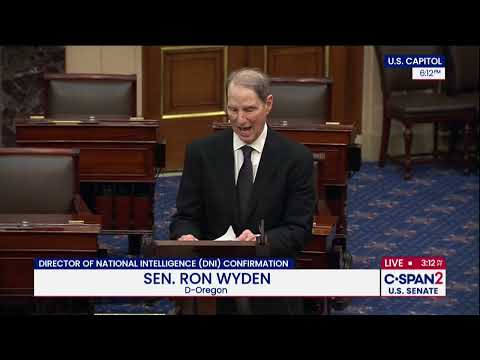
A senator on the Senate floor urged colleagues to oppose Jay Clayton's nomination to be director of National Intelligence, citing repeated public promotion of election conspiracy theories, involvement in subpoenas against New York Times journalists that were withdrawn by courts, disputed testimony to an intelligence committee, and questions about conduct in high-profile investigations.
A senator on the Senate floor urged colleagues to oppose Jay Clayton’s nomination to be director of National Intelligence, saying Clayton has "repeated baseless conspiracy theories about American elections" and has used his positions to defend former President Donald Trump.
The senator criticized Clayton’s public remarks about election integrity and vote-by-mail, noting Clayton — then U.S. Attorney in the Southern District of New York — appeared on television and, on June 8, suggested a "one group approach" was using vote-by-mail dishonestly. The senator said that was "ridiculous," adding that vote-by-mail "benefits rural voters" and older people and has not historically been partisan.
The senator also accused Clayton of signing subpoenas directed at journalists at The New York Times and said the resulting legal proceedings revealed errors by government attorneys; the government ultimately withdrew the subpoenas after a judge criticized the effort. "He's responsible for the effort to intimidate the press," the senator said.
On Clayton’s testimony to congressional oversight, the senator said that eight days before the court hearing that exposed those errors, Clayton had testified repeatedly to the intelligence committee that the government had "followed all the required procedures," a claim the senator said proved false in light of the court proceeding. The senator framed the discrepancy as a central question for the Senate: whether Clayton knowingly misled Congress or was unaware of actions taken under his own signature.
The senator also recounted Clayton's on-air defense of a settlement that shielded the Trump family from a tax audit, quoting Clayton as saying it "was a pretty good deal for the government," and noted the senator's assertion that a judge later found that settlement "improper" and without "viable basis in law or fact." The senator said Clayton "was happy to go on television and defend the corruption."
Finally, the senator raised Clayton's role in investigations related to Jeffrey Epstein, accusing him of responsibility for the "inexcusable release of information on Epstein's victims" and saying Clayton had declined to discuss other aspects of the files. The senator concluded that Clayton has "no business being confirmed" given the combination of alleged actions and urged senators to oppose the nomination, then yielded back the floor.
The remarks aired concerns about Clayton’s public comments on elections, his handling of subpoenas to journalists, possible inconsistencies between his testimony and subsequent court findings, and his conduct in high-profile matters. The senator called for the Senate to continue scrutiny rather than rush to confirm Clayton.