Get Full Government Meeting Transcripts, Videos, & Alerts Forever!
Get email alerts on the Affordable Housing topic
No spam. Unsubscribe anytime.
Committee weighs TIF, PILOT and LIHTC to advance affordable housing
Summary
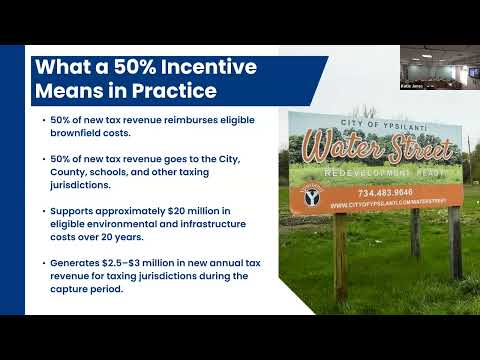
Members debated how TIF, payment‑in‑lieu‑of‑tax (PILOT) and federal low‑income housing tax credits (LIHTC) can be combined to achieve affordable units on Water Street; staff said PILOTs typically produce modest local revenue and TIF can be structured to subsidize remediation and infrastructure costs that otherwise make affordability infeasible.
Committee members pressed staff on whether TIF alone or paired tools could deliver affordable housing on Water Street. The presenter said the state and federal system often requires pairing LIHTC with a payment‑in‑lieu‑of‑tax (PILOT) to bridge financing gaps. “A payment in lieu of tax is…based on the shelter rents that are paid,” the presenter explained, adding city PILOT rates in prior projects ranged from 1% to 10% and typically generate modest sums (she said PILOTs in local examples bring in roughly $50,000 to $100,000).
The presenter argued that when structured carefully a TIF can subsidize expensive remediation and infrastructure costs so a project becomes financially viable without producing rents that are unaffordable locally. Committee members pointed to Dorsey Estates as an example where large public incentives lowered sales prices for new homes; one member noted mixed-income integration at some projects and urged pursuing mixed-use, mixed-income approaches rather than isolating subsidized housing.
Questions remained about target percentages for deed‑restricted affordable units; members agreed to gather more examples and to refine targets during developer negotiation rather than prescribe an absolute percentage in the RFQ.