Get Full Government Meeting Transcripts, Videos, & Alerts Forever!
Get email alerts on the Tax Revenue topic
No spam. Unsubscribe anytime.
Presenter outlines conservative TIF revenue scenario for Water Street
Summary
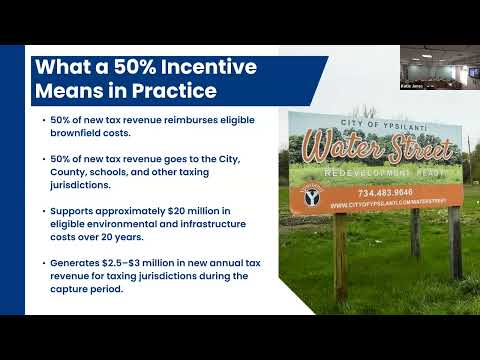
At a committee briefing, the presenter sketched a conservative $150 million Water Street buildout with a $75 million assessed value that could generate roughly $5–6 million in total annual tax revenue; the city’s share was estimated at about $1.7–$2.0 million under current levy splits.
The committee heard a staff presentation on how tax revenue from a hypothetical Water Street redevelopment could materialize. The presenter said the city’s total taxable value is $433,000,000 and that a conservative development estimate of $150,000,000 would yield a taxable value of about $75,000,000. “That would bring an estimated 5 to $6,000,000,” the presenter said, noting that figure represents total taxes levied across all jurisdictions, not only the city.
The presenter broke down the city’s expected share under current levy rules: “The city would be 1.7 to $1.99,” she said, adding that those numbers would be a significant budgetary impact for the city if realized. She stressed the numbers are illustrative, not contractual, because taxable values are driven by state law, fluctuating market conditions and the assessor’s methodology.
Committee members asked whether infrastructure installed by a developer—sewer, water, roads—counts toward taxable value. The presenter said developers commonly install utilities and later convey them to the city; the cost is usually in the developer’s pro forma and may increase overall project value. She cautioned that different property types use different assessment approaches—sales comparison for single-family, income approach for rentals and a cost approach for commercial real estate—so projections depend heavily on what gets built.
The committee agreed the example was a useful starting point for RFQ discussions and asked staff for more detailed, slide-backed figures to be circulated after the meeting.