Get Full Government Meeting Transcripts, Videos, & Alerts Forever!
Get email alerts on the Energy Policy topic
No spam. Unsubscribe anytime.
Council urges lawmakers not to subsidize new nuclear projects; motion passes
Summary
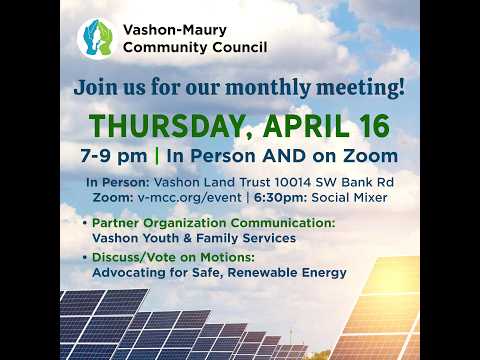
After a presentation on energy policy, the council passed a motion asking King County and state and federal legislators to reject tax preferences, subsidies or legislation that would expand the nuclear industry and to instead prioritize renewable energy and storage solutions.
The Vashon-Maury Community Council voted to send a policy preference to elected officials asking them not to use taxpayer dollars to subsidize advanced nuclear projects and to prioritize renewable energy and storage.
The motion followed a presentation introduced by the chair and delivered by a presenter identified in the meeting as Ken Jones, who argued that small modular reactors carry risks including historical cost overruns, radioactive waste disposal challenges and worker-safety concerns. "It doesn't say that you can never build one. It says we do not want our taxpayer dollars going to subsidize them," the presenter said while urging support for wind, solar and storage alternatives.
Council discussion featured technical and regulatory arguments on both sides. Supporters cited failed projects, long waste-management timelines and tribal opposition; opponents questioned whether emerging reactor technologies could improve safety and handling of waste and urged cautious study. A recorded roll call at the meeting showed a majority in favor and the chair declared the motion passed.
The council's operative clause asks King County, state and federal legislators and the governor to reject tax preferences, subsidies and legislation that expand the nuclear industry in Washington and to favor safe, affordable renewable options.