Get email alerts on the Zoning Standards topic
No spam. Unsubscribe anytime.
County proposes overlay districts and stricter standards for data centers and conservation
Summary
Planners recommended a set of overlay districts — including cluster conservation and planned mixed-use overlays — and proposed standards such as 50% open-space retention in cluster conservation and a preconditioned noise study for data centers.
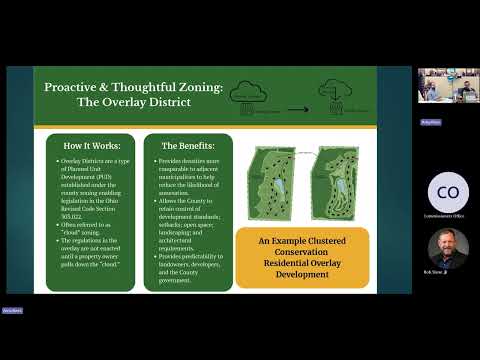
County planning staff described a package of overlay districts designed to align zoning text with the comprehensive land-use map. The proposed overlays include planned residential, cluster conservation, planned business, planned mixed use and a highway-oriented 161 overlay; staff said overlays let the county include architecture, buffering and landscaping standards tied to the comprehensive plan.
As an example, staff said cluster conservation residential districts would require retaining 50% of a tract as open space. Presenters also proposed clearer general development standards, including height limits and larger buffers intended to manage large industrial or campus-style uses such as data centers.
On data centers specifically, staff said the draft would require an existing noise study before approval and call for more integrated landscaping using native plantings. "We want to make sure that landscaping is a little bit more integrated, with native plantings," a presenter said. The proposed rules are intended to prevent low-effort mitigation (for example, a small berm and a row of pine trees) and to require practices that protect ecological resources such as water systems.
AI generated
The text on this page is AI generated. Summaries, highlights, analysis, and video transcripts are all produced from the original source material.
AI can make mistakes, so if you spot one, and we will fix it for everyone.
Note: the source content is unaltered by us. Any content source we link to, be it a video, an audio recording, or a document, is presented exactly as its publisher released it. That publisher is usually a government body, sometimes an individual official or another organisation.