Get Full Government Meeting Transcripts, Videos, & Alerts Forever!
Get email alerts on the Critical Areas topic
No spam. Unsubscribe anytime.
Monroe staff presents overhaul of critical‑areas rules, schedules Aug. 24 public hearing
Summary
City planning staff proposed a comprehensive rewrite of Monroe’s critical‑areas code—covering wetlands, streams and new critical‑aquifer protections—and outlined agency and tribal comments, mitigation sequencing, and a timeline with a public hearing tentatively set for Aug. 24.
Kate, a staff member leading the rewrite, told the Planning Commission the packet for workshop #2 includes comments from state agencies and tribes and that staff conducted the rewrite in‑house using Department of Commerce, Ecology, Fish & Wildlife and DNR resources. "We have 1 more workshop set up for you, then the public hearing, and then hopefully, you'll be ready to, adopt findings for council and then have this going to council in September, October," she said.
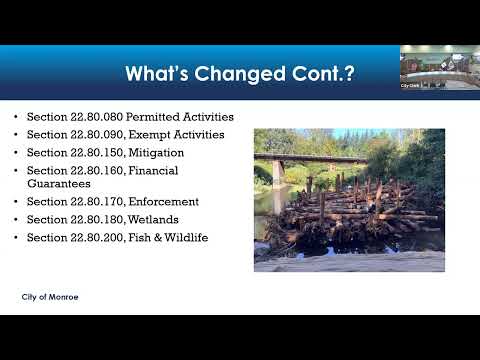
Kate reviewed the code context and history: the city’s current rules are in Monroe Municipal Code chapter 2,280 with major updates adopted in 2005 and 2017, and a limited 2019 change that introduced stream water typing. She emphasized the draft’s reorganization—separating permitted, exempt and reasonable‑use sections—and clarified the Critical Areas Report process, financial guarantees and new enforcement language intended to ensure replantings survive.
The draft folds stream protections into a broader riparian management zone, using Department of Fish & Wildlife mapping and site‑potential tree height models that can change buffer widths. Kate noted the state volumes recommend a 100‑foot minimum buffer for shading and stormwater benefits; applying SPTH could increase shoreline buffers by roughly 15 feet and fish‑bearing stream buffers by up to about 35 feet in some areas, and staff is still working through extreme cases shown in the report.
Staff said they have received comments from the Tulalip and Snoqualmie tribes and Fish & Wildlife and will return a staff‑response matrix to commissioners in a future packet. No formal action or vote occurred; the commission set a path for one more study session and a tentative public hearing on Aug. 24 before any Planning Commission findings or transmittal to City Council.