Get Full Government Meeting Transcripts, Videos, & Alerts Forever!
Get email alerts on the After School Expansion topic
No spam. Unsubscribe anytime.
Sunnyvale board hears plan to expand after‑school 'KLAS' but staff warn program is at capacity
Summary
District staff reported KLAS and after‑care enrollment rose to 698 students this year, flagged 20:1 supervision ratios and said the district is holding 10% of spots for ELOP‑eligible families while exploring staffing and facility model changes.
Paul Slayton, director of student support services, told the Sunnyvale School District board the district expanded after‑school options this year but has reached operational limits as enrollment climbed from 551 to 698 students.
"Starting this year, as of, I think, earlier this week, we're at 698 students," Slayton said. He said the current supervision ratio for grades 1–5 is "20 students per 1 adult," and that further increases without a staffing and model change would "reach the limit" for both facilities and staff.
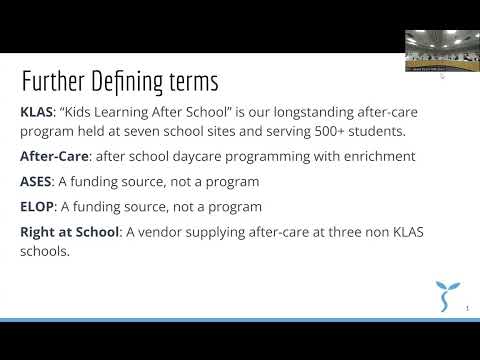
Slayton described KLAS (Kids Learning After School) as a long‑standing district program and said the district now offers aftercare at all 10 schools. He said the district has partnered with vendors for some sites and added curricular partners such as Forza for arts, dance and coding.
To protect access for the grant‑prioritized populations the ELOP grant requires — foster youth, students experiencing homelessness, English learners and low‑income students — staff told trustees they reserved roughly 10% of spots at each school "vacant for enrolling families that are ELOP qualified." "It's between 5 and 8 spots at every school," Slayton said, describing that as a first‑year procedure to balance equity against expanding total capacity.
Board members pressed staff on next steps if demand continues to outpace capacity. Staff said options include hiring additional paraprofessionals and a detached supervising lead for larger sites, expanding use of multiuse rooms and exploring community partnerships that would place programs where families live. Staff warned the staffing model will be the major constraint and that changes will raise costs and require operational changes.
The board did not take an action on program expansion at the meeting; Slayton said staff will continue to evaluate incremental changes and report back on costs and feasibility.