Get Full Government Meeting Transcripts, Videos, & Alerts Forever!
Get email alerts on the Wildlife Management topic
No spam. Unsubscribe anytime.
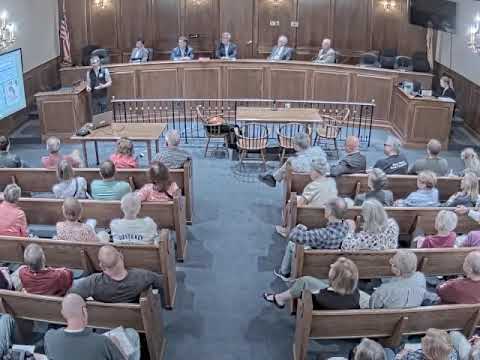
NJ DEP biologist outlines deer-management options to Old Tappan council
Summary
A New Jersey DEP biologist explained the trade-offs among fertility control, relocation, and lethal management for rising deer conflicts in Old Tappan, stressing that choices involve safety, cost and regional coordination; residents pressed the council for next steps.
A New Jersey Department of Environmental Protection biologist presented an overview of strategies to address Old Tappan’s growing deer problems, outlining how human health, ecosystem health and economic damage factor into decisions.
“More or less with overabundant deer populations, the indicators…can be binned into these three things: human health, ecosystem health and economic impacts,” said Brian Schum, identifying himself as a senior biologist with the New Jersey DEP Fish and Wildlife Bureau. Schum told the council the presentation was educational and not a push for a specific policy.
Schum described a “bucket” model for population dynamics — birth rate and immigration fill the bucket while death and emigration drain it — and presented four broad management approaches: encouraging predators, trapping and relocation, fertility control (chemical or surgical), and various forms of lethal management, including managed or contracted hunting. He warned that fertility programs require very high treatment rates to be effective and cited study ranges of roughly $1,000 to $4,100 per treated deer in some cases.
On lethal options, Schum emphasized safety and local land-access constraints: “There’s a 150-foot safety zone for archery equipment…with firearms, you have to be 450 feet away from any occupied dwellings,” he said, noting towns often choose archery-only programs for suburban areas. He said managed or contracted hunts can provide stronger control but can also raise public controversy.
The biologist urged municipal and county coordination. “It’s local and it’s regional,” Schum said, explaining that deer have small home ranges and that a single municipality acting alone may see limited relief unless neighboring jurisdictions cooperate.
The council did not take any formal policy vote at the meeting; Schum and council members said the material will inform future deliberations and vendor consultations.