Get Full Government Meeting Transcripts, Videos, & Alerts Forever!
Get email alerts on the Land Development topic
No spam. Unsubscribe anytime.
Developers pitch phased revival of old Wyndham site; neighbors raise noise, parking and dog concerns
Summary
Applicant for the former Wyndham property told council it wants a two‑phase home‑rule development agreement to reopen restaurant and recreation uses now and complete a permanent restaurant, pool and wave‑dissipation wall in phase two. Neighbors won intervener status and pressed for limits on overnight camper parking, dogs and the exact location of the wave wall.
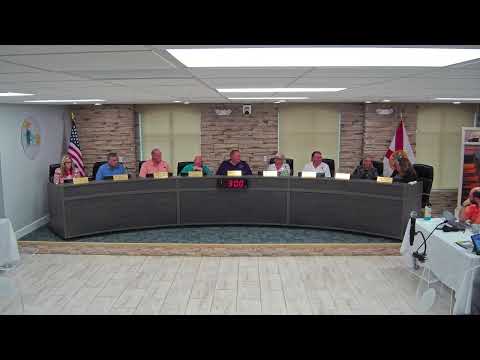
Fort Myers Beach council heard a multi‑hour presentation Aug. 3 from attorneys and planners for the redevelopment of the site formerly occupied by the Wyndham hotel at 6890 Estero Boulevard. Megan Strayhorn, attorney for the applicant, said the proposal is a home‑rule development agreement with two phases: an interim phase using trailers for food service and a second phase that would build permanent amenities including a tiki‑barn or pole‑barn restaurant, pool and a lazy river.
Patrick Venas, the project planner, told council the team sought to “reestablish preexisting uses” except the hotel and emphasized steps it says will reduce impacts on neighbors: a plan for controlled, valet‑only parking in the second phase, a multiuse path extending to the beach and limited hours for amplified live music. “This is not a food truck park, folks,” Venas said, adding the applicant will operate a single permanent restaurant and that trailers are only a temporary measure pending FEMA map changes tied to a proposed wave‑dissipation wall.
Neighbors who asked for intervener status — the Sandpiper Condominium Association’s president, Larry Gillum — told council they worry about overnight camper parking, dogs and the distance and design of any wave wall, which could affect adjacent shorelines. Gillum said he wanted the developer to commit that camper parking would not be allowed overnight and to explore prohibiting pets other than service animals. He also asked that the mitigation wall stop well short of the association’s property and that alternatives be examined to avoid redirected wave impacts.
Strayhorn said the applicant will commit to no overnight camper parking and to signage limiting parking to patrons. She said the project team is not comfortable writing a dog ban into the development agreement because federal protections for service animals and other authorities are in play, but said they would work with the town on signage and environmental protections near the critical wildlife area. On the wave wall, the applicant said FEMA will determine the precise alignment after engineering review.
Council granted intervener status to the neighbors and spent major portions of the hearing asking staff and the applicant detailed questions about parking counts, buffers, sound mitigation and operations. Staff and applicant materials show the overall property is about 11.2 acres, with roughly four acres of the proposed development area seaward of Estero Boulevard; the applicant said phase 1 would provide about 163 parking spaces versus a code requirement of 144, and phase 2 would add parking to reach 237 spaces in total.
Council did not vote on the development agreement at the Aug. 3 meeting. The applicant incorporated multiple recommended changes from the local planning authority (LPA) and acknowledged several outstanding items, such as landscaping details, exact placement of the wave‑dissipation wall and formal language for park‑and‑valet operations. The council indicated it would continue to review the development agreement and related conditions at a future hearing.