Get Full Government Meeting Transcripts, Videos, & Alerts Forever!
Get email alerts on the Watershed Management topic
No spam. Unsubscribe anytime.
Consultant details Muscoma Lake watershed plan, urges local action to cut phosphorus
Summary
FB Environmental summarized the Muscoma Lake Watershed Management Plan, identifying watershed runoff as the dominant phosphorus source and recommending an implementation committee, road standards, septic attention and targeted stormwater projects to meet reduction goals.
Forrest Bell of FB Environmental presented the Muscoma Lake Watershed Management Plan to the Enfield Select Board, describing the 18‑month study as “a practical guide that identifies the problem, sets the goals and outlines” how to address water‑quality threats to Muscoma Lake. Bell told the board the lake’s watershed is unusually large — roughly 98,000 acres draining to a 1,100‑acre lake — and noted the lake’s high flushing rate of about 6.5 times per year.
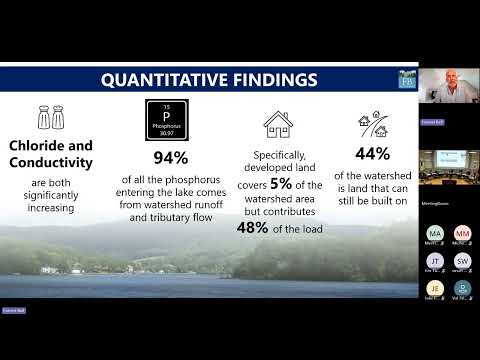
Bell called out nutrient pollution as the dominant threat: “94% of all the phosphorus entering the lake comes from watershed runoff and tributary flow,” he said, and added that developed land comprises only about 5% of the watershed but contributes roughly 48% of the phosphorus load. He also said the plan identified about 222 septic systems around the lake that are more than 25 years old and flagged shoreline erosion and unbuffered lawns as contributors.
The plan sets two measurable objectives: to reduce the current phosphorus load by about 86 kilograms per year (a roughly 4% reduction) and to mitigate an estimated 475 kilograms per year of phosphorus tied to future build‑out over the next decade. Bell described an action plan of some 46–49 prioritized recommendations that assigns parties, estimates costs, suggests funding sources and outlines how to measure progress.
Among the top recommended actions Bell highlighted infrastructure work and policy changes: improved stormwater treatment and low‑impact development ordinances, conservation subdivisions and stronger shoreline and wetland protections. He said upgrading road performance standards for paved and unpaved roads within 50 feet of surface waters could account for roughly 36% of the mitigation target.
Select Board members and residents pressed for implementation steps. Board members asked how Enfield could work with neighboring towns and the state, and Bell recommended forming an implementation committee that includes New Hampshire Department of Transportation and other stakeholders so “the right people are in the room.” Multiple residents urged concentrating on “low‑hanging fruit” such as town‑owned stormwater control management sites and shorefront septic work, and Dan Regan (New Hampshire Lakes) summarized the plan’s priorities as roads, septic systems and stormwater controls, which the steering committee estimates together would achieve nearly all the plan’s goals.
The presentation concluded with agreement from board members to take next steps, including further outreach to Lebanon and Canaan, and to consider placing implementation and potential adoption of the plan on a future Select Board agenda for formal action.