Get Full Government Meeting Transcripts, Videos, & Alerts Forever!
Get email alerts on the Theranostics Expansion topic
No spam. Unsubscribe anytime.
Board approves $9.3 million theranostics expansion at Huntsman Cancer Institute
Summary
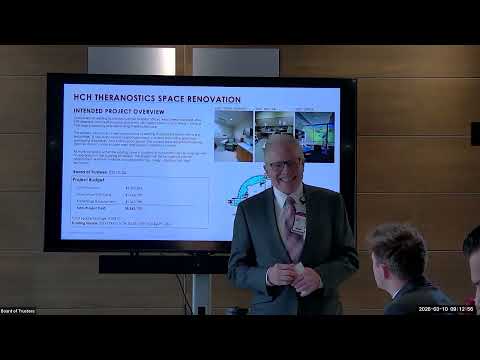
Trustees approved design and construction of a theranostics and early‑trials infusion suite at the Huntsman Cancer Institute, a roughly $9.29 million project that would add 11 theranostic rooms and eight infusion rooms and is planned to start in July with a 16‑month construction timeline.
The University of Utah Board of Trustees voted to approve design and construction of an expansion at the Huntsman Cancer Institute to house theranostics services and early‑trials infusions.
Gina Holly, introduced to the board as an associate chief operating officer for uHealth, described theranostics as a targeted therapy that pairs diagnostic radiology with radiopharmaceuticals to attack tumors while protecting healthy tissue and said the project will expand capacity from three current rooms to 11 theranostic rooms and eight early‑trials infusion rooms. “Theragnostics, for those who are not aware, it's a really transformative therapy that uses diagnostic radiology and radiopharmaceuticals to deliver radiation to an area where there's cancerous cells, but it protects the healthy cells around it,” Holly said. Don Milligan, identified as a chief administrative officer for the hospital, framed the expansion as supporting clinical care, trials and the hospital’s academic mission.
Materials presented to the board list the project budget at $9,292,500 and break costs into construction, soft costs and equipment; presenters also referenced a closely similar figure in the materials. Trustees asked about schedule and were told work would begin in July with an estimated 16‑month timeline. A motion to move forward with design and construction was made, seconded, and approved by voice vote; the motion was introduced in the meeting with a mover and second, and no roll‑call tally was provided in the public remarks.
The presentation noted reimbursement from Medicare and commercial payers and a research component supported by an HCI contribution; trustees were told expanded capacity would support more clinical trials. The board packet and presentation materials contain the detailed budget breakdown and timeline.