Get Full Government Meeting Transcripts, Videos, & Alerts Forever!
Get email alerts on the Risk Management topic
No spam. Unsubscribe anytime.
CIRA gives Blue Lake council a primer on pooled risk, coverages and local tools
Summary
At the March 11 Blue Lake City Council meeting, Eurek Young of the California Intergovernmental Risk Authority (CIRA) explained how pooled risk sharing, deductibles and excess layers work, and described training, grant and contract‑review services available to small cities including Blue Lake.
Eurek Young, deputy general manager of the California Intergovernmental Risk Authority, told the Blue Lake City Council on March 11 that CIRA’s aim is to help smaller cities manage and prevent costly claims while providing pooled coverages they could not buy individually. "My name is Eurek Young. I'm the deputy general manager for CIRA," he said when introducing the presentation.
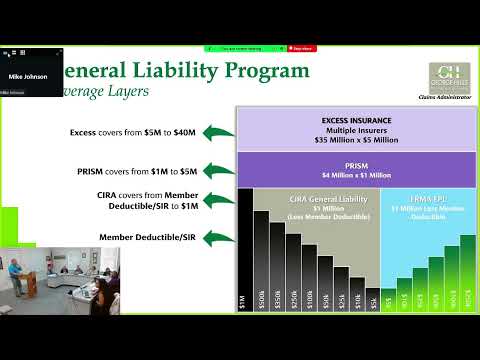
Young explained that CIRA is a joint powers authority formed by a recent merger and now serves about 60 members. He described how the pool constructs coverage "towers" with member deductibles that can range from $5,000 up to $1,000,000 and excess insurance purchased through a second JPA such as PRISM; together those layers can provide tens of millions in coverage for large claims. The presentation also covered third‑party administrators ("George Hills" for general liability) and how claim reporting interacts with government claim statutes and defense counsel assignments.
Young emphasized programs aimed at preventing losses: annual risk assessments, on‑site trainings and contract review to transfer risk through indemnity and additional‑insured endorsements. He also flagged member resources including an employment‑law consortium (LCW), an online training library (Vector Solutions) and small grants such as a $2,500 annual training grant available to members. "We have forms. We've done a public works form the year before focused on back injury prevention," he said, describing proactive risk‑control work.
Why it matters: the presentation frames insurance and loss prevention as complementary tools for budget planning. For small cities that lack dedicated risk managers, Young said CIRA acts as a staff extension to help with inspections, contract language and training so local officials can focus limited staff time on high‑priority fixes. The council asked several follow‑up questions about payroll basis for rates, whether council members are covered by work comp while performing duties, contract review coordination with city attorneys and cyber‑security audit offerings; Young answered that payroll dollars (not benefits) are the standard exposure base and confirmed volunteers and council members acting in their official capacity are generally covered by workers' compensation.
Next steps: Young offered follow‑up consultations and promised to provide model ordinance language and resource links (for example, the League of Cities white paper on sidewalk transfer ordinances) to staff for any items (sidewalks, bike‑park design, encroachment permitting) the council wants to pursue.