Get Full Government Meeting Transcripts, Videos, & Alerts Forever!
Get email alerts on the Tif topic
No spam. Unsubscribe anytime.
New TIF limits in SF 2472 prompt council to consider changing incentives and TIF policy
Summary
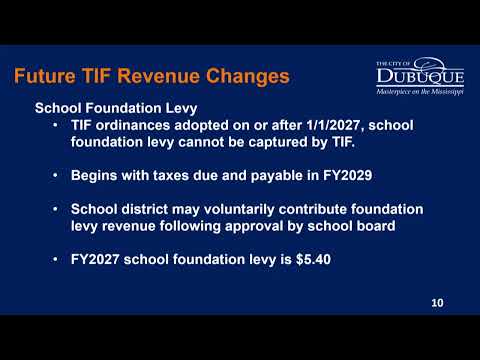
CFO and the city manager warned that the bill’s TIF changes—a 23-year limit for new TIFs, a 60/40 distribution for existing open-ended TIFs beginning in 2047, and exclusion of school foundation levies from capture for new ordinances—will affect Dubuque’s redevelopment planning and whether the city offers rebates for market-rate projects.
Jennifer Larson summarized the bill’s TIF provisions and told the council the changes will have direct implications for redevelopment agreements and long-term TIF projections. She noted that new TIF ordinances adopted after May 18, 2026 will be limited to a 23-year collection period and that existing TIF ordinances without sunsets—such as the Greater Downtown TIF—will face a 60% cap on increment with 40% distributed to other taxing bodies beginning in fiscal year 2047.
City manager Michael Van Milligen told the council these rules could change the calculus for offering TIF rebates. He noted that any value released from a TIF district will not be counted as new growth for the 2% cap, meaning the city could forfeit expected future general-fund gains by providing TIF incentives. "So the city council is gonna have to have that discussion on, are we going to offer less, TIF incentives so that any new growth we do get does add to the general fund resources?" Van Milligen asked. He urged an early policy discussion on whether to limit TIF rebates for market-rate projects or to reserve incentives for workforce or affordable housing.