Get Full Government Meeting Transcripts, Videos, & Alerts Forever!
Get email alerts on the Sf2472 topic
No spam. Unsubscribe anytime.
Dubuque council reviews sweeping changes in Iowa Senate File 2472; many implementation questions remain
Summary
City finance staff briefed the council on Senate File 2472, which introduces a 2% general-fund levy cap, phases out state replacement payments, converts homestead credits to an exemption, limits reserves, restricts certain debt, and alters TIF rules. Officials said key guidance is pending from the Iowa Department of Management.
The Dubuque City Council held a special session Aug. 3, 2026 to consider the financial and policy impacts of Iowa Senate File 2472. Chief Financial Officer Jennifer Larson told the council the legislation "makes significant changes to the Iowa's property tax system and to the financial rules that govern, cities." She said most major provisions are effective July 1, 2027, but several are effective immediately or earlier for budget planning.
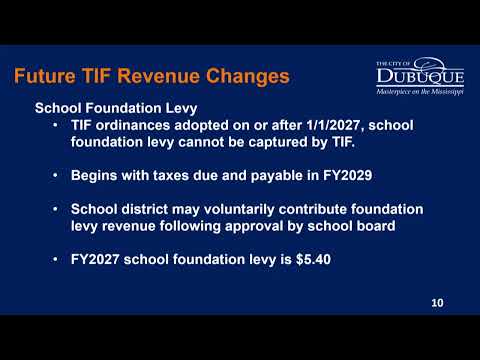
Larson outlined a package of interlocking provisions: a capped general-fund levy growth set at 102% of prior-year property tax dollars for fiscal years 2028–2030 and a double limitation after FY2031 tied to the statutory 8.10 levy; the phase-out of state replacement payments to local governments; the conversion of the homestead credit to a homestead exemption; a 35% cap on unassigned general fund reserves with audit compliance; new restrictions on property-tax-supported debt for operating expenses; and multiple changes to tax increment financing (TIF), including a 23-year collection limit for new TIFs and distribution changes affecting existing TIF districts.
City officials repeatedly warned the council that many implementation details remain unresolved and hinge on guidance from the Iowa Department of Management. Larson told the council she and staff are tracking numerous questions—about whether trust-and-agency levies are excluded from the cap, how prior-year actual property-tax dollars will be calculated, which expenditures qualify as "obligated funds" for the reserve exception, and how existing development agreements will be treated. "We still have a lot of unanswered questions, which we're hoping are addressed by the Iowa Department of Management," she said.
Mayor and council members thanked staff for the analysis and agreed the city must coordinate with state agencies, bond counsel, and the Iowa League of Cities to clarify implementation before the local budget process advances.