Get Full Government Meeting Transcripts, Videos, & Alerts Forever!
Get email alerts on the Transmission Project Overview topic
No spam. Unsubscribe anytime.
Dairyland, NextEra outline Maribel 765 kV segment and timeline; county raises routing questions
Summary
Dairyland Power and partner Gridline/NextEra presented the Maribel 765 kV transmission project to the Vernon County Board, describing a roughly 39–40 mile Wisconsin segment, a permitting schedule that aims for a CPCN filing later this year, and in‑service in 2034; supervisors pressed presenters on routing, taxes and how counties can participate in the PSC docket.
Dairyland Power Cooperative representatives and partner Gridline/NextEra briefed the Vernon County Board on the proposed Maribel 765 kilovolt transmission segment, describing the Wisconsin portion as roughly 39–40 miles and saying construction prework could start in 2031 with full operation targeted for 2034. “My name is Luke fuller. I work for Dairyland Power on the government relations and grants team,” said Luke Fuller, who led the presentation and described the regional planning by MISO that produced the tranche 2.1 projects.
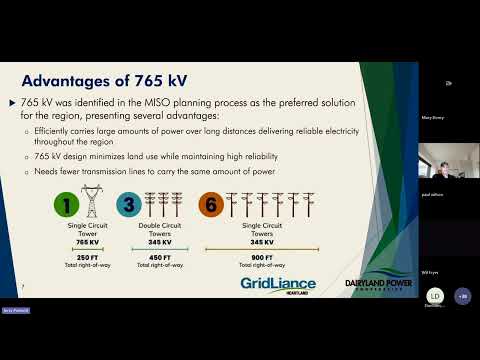
Laurie Dunham of Gridline/NextEra said MISO’s tranche work involved a multi‑billion dollar regional portfolio and that Dairyland was assigned the Maribel portion because of existing 161 kV infrastructure. Dunnham summarized the public outreach plan and schedule: “We have open houses in November and January… we anticipate the 2nd round of open houses in Wisconsin will be on March 10 and March 12.” Presenters said right‑of‑way widths are estimated up to about 250 feet and tower structures are expected in the 150–200‑foot range depending on siting constraints.
Presenters emphasized that Wisconsin’s Public Service Commission (PSC) issues the Certificate of Public Convenience and Necessity (CPCN) and determines the final route. Fuller described the regulatory timeline, saying an application would be prepared later this year and that the state CPCN and route decision typically takes about a year. He told supervisors the developer will propose an initial route and an alternative as part of the application and that parties and landowners can intervene in the docket to become formal participants.
Why it matters: the line is a multi‑state transmission project intended to increase capacity and reliability across the MISO footprint; however, the proposed route and the scale of right‑of‑way and towers raised immediate concerns from supervisors and residents about local environmental impacts, property effects and county options for influence.
Next steps: presenters reiterated outreach (website maribeltransmission.com, email connect@maribeltransmission.com), scheduled Wisconsin open houses March 10–12 and said they will notify clerks and supervisors when the PSC docket for Wisconsin is filed so local officials can intervene or submit comments.