Get Full Government Meeting Transcripts, Videos, & Alerts Forever!
Get email alerts on the Land Use topic
No spam. Unsubscribe anytime.
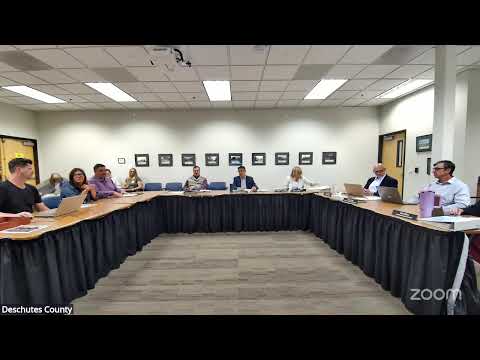
Planning manager outlines narrow remand edits to Deschutes County 2040 comprehensive plan
Summary
Staff told the board the remand to Ordinance 2025-07 will narrowly amend policies 10.1.0.3 and 10.1.0.4 to clarify treatment of differing rural-residential subtypes and avoid creating self-executing lot‑size or density standards; staff said additional code fixes are likely in the coming year to align county code with state OAR requirements.
Will Groves, the county planning manager, told the Board of Commissioners that the remand tied to Ordinance 2025-07 is intentionally narrow, focusing on splitting and clarifying policy 10.1.0.3 and creating 10.1.0.4 to define non-resource lands and their treatment under state law. He said the remand responds to a board order and to guidance from LUBA and the Oregon Administrative Rules (OAR 660-004-0040).
"Scope of the remand is intentionally narrow per the board order," Groves said, adding that the amendments do not reopen unrelated comprehensive plan provisions and "don't establish independent lot size to parcel size or density standards." He warned that planned-unit development code currently lacks a minimum lot-size and that state rules may not recognize lots smaller than two acres as inherently rural, which creates goal‑14 and procedural complications. Groves said staff will return with further code amendments and plan amendments to align clustered and planned-unit subdivisions with state law in the coming year.
Board members asked practical questions about what the county code currently allows for cluster and planned-unit developments, minimum acreage thresholds for PUDs and how to guide applicants through state and county requirements. Groves explained that planned‑unit developments generally require 40 acres, clusters can operate on smaller parcels, and protective open-space agreements are commonly used to hold remainder land in perpetuity.