Get Full Government Meeting Transcripts, Videos, & Alerts Forever!
Get email alerts on the Environment topic
No spam. Unsubscribe anytime.
Residents urge New Haven to weigh environmental justice, noise and utility impacts before allowing data centers
Summary
Multiple public commenters told the committee that data centers can produce heavy noise, water and power demands and disproportionately burden low‑income neighborhoods; they urged performance‑based standards, community benefits and use of Connecticut's environmental justice statute as a model.
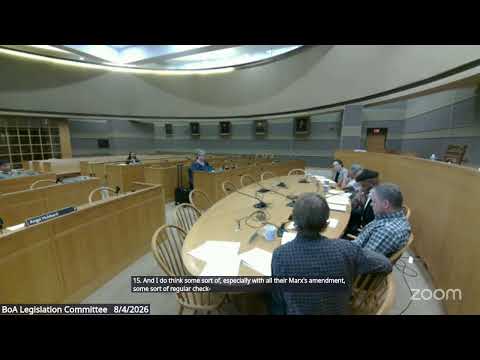
At the legislation committee hearing on Aug. 4, several residents and civic leaders urged Alders to proceed cautiously before allowing new data‑center projects in New Haven. Speakers raised concerns about electricity and water consumption, heat and noise emissions, and the potential for disproportionate impacts on low‑income, majority‑Black and Latino neighborhoods.
Laura Khan, a former chair of the city’s Environmental Advisory Council, said the council has recorded adverse health impacts associated with loud noise and urged explicit protections. She told the committee, “They use a lot of electricity and water and a lot of heat, and they also make noise,” and asked that the moratorium and follow‑up zoning address noise as a public‑health issue.
Other commenters connected local decisions to broader equity and international concerns. Manuel Camacho, chair of the City of New Haven Peace Commission, said the United Nations is wrestling with AI and data‑center impacts and urged the city to consider global as well as local consequences. A public commenter who identified himself as Aaron recommended performance‑based triggers (for example, electricity or water use thresholds and decibel limits) rather than solely defining uses by equipment type.
Speakers also suggested the committee use Connecticut’s environmental justice framework (Conn. Gen. Stat. §22‑20a) to strengthen community notification, multilingual outreach and negotiations for community benefits where appropriate. The testimony reinforced staff recommendations for more time to study impacts and for the City Planning Commission to hold hearings on zoning implications.