Get Full Government Meeting Transcripts, Videos, & Alerts Forever!
Get email alerts on the Community Solar topic
No spam. Unsubscribe anytime.
Committee advances City Light overhaul to expand community solar access for low-income customers
Summary
The Parks & City Light Committee recommended passage of Council Bill 121261, which would modernize Seattle City Light's authority to design and administer community solar and allow voluntary green power funds to support projects that benefit income-qualified customers.
The Parks & City Light Committee on Aug. 5 voted 4-0 to recommend passage of Council Bill 121261, a measure to update Seattle Municipal Code language so City Light can design and operate new community solar programs. Chair Juarez moved the recommendation and Council member Rivera seconded; Council members Strauss and Saka joined the aye votes.
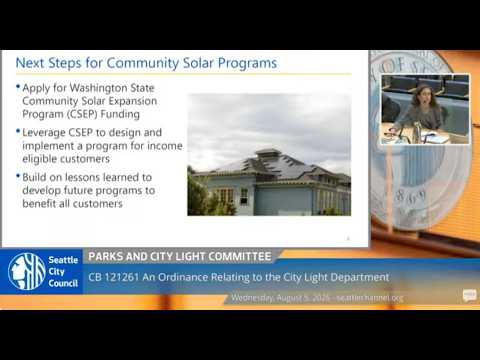
Alex Portashaver, who oversees customer solar and battery programs at Seattle City Light, told the committee that the ordinance would clarify City Light's authority to build and manage community solar and to use voluntary green power program funds as one funding source. "Community solar is any solar project where the benefits flow to multiple customers," he said, describing projects sited on utility facilities or community hosts such as food banks and allocating bill credits to participating customers.
City Light framed the proposal as an equity-focused program aimed at renters and low- and moderate-income households who cannot install rooftop panels. Portashaver said the utility aims to leverage Washington State University's community solar expansion funding established by House Bill 1814 (2022) and noted that a remaining $50,000,000 of the program allocation could support up to 4 megawatts of solar-plus-battery projects. "If we built 4 megawatts, that's our goal — we could serve about 700 customers," he said while cautioning that design choices will determine breadth versus depth of benefits.
Council members pressed staff on eligibility thresholds and racial equity considerations. Portashaver explained that the state grant requires benefits to be offered to customers at or below 80% of area median income (AMI) for at least 10 years, while City Light could design program eligibility to mirror the utility discount program (which is aligned nearer 60% AMI). "We don't generally put program eligibility in the ordinance because it allows flexibility to mimic utility discount program changes," a City Light presenter said.
Supporters who spoke during public comment included Bradley Dosh, a solar developer, who cited Department of Energy figures and urged Seattle to expand community solar capacity. A remote commenter raised budget and property-protection concerns; City Light staff said the ordinance clarifies authority and does not itself obligate perpetual property interests.
The committee forwarded the bill to the full Council with a recommendation of passage; the item is scheduled for the Aug. 11, 2026 Council docket.