Get Full Government Meeting Transcripts, Videos, & Alerts Forever!
Get email alerts on the CRISP Send Service topic
No spam. Unsubscribe anytime.
CRISP highlights governance, real‑time ADT ‘send’ service and broad notification reach in Maryland
Summary
CRISP described its shared‑services model, technical pipeline and controls, reporting that roughly 90% of Maryland hospital discharges generate a notification to some recipient and that Maryland operates as an opt‑out HIE with very low opt‑out rates.
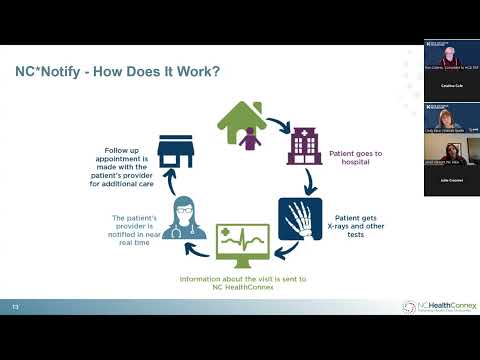
Craig Bem of CRISP (Chesapeake Regional Information System for our Patients) outlined CRISP’s evolution from an independent nonprofit to a statewide designated HIE and emphasized governance, provenance and service controls layered on a central data platform. He said CRISP’s shared‑services arm provides technology and staffing to multiple states and that their send/ADT service compresses multiple ADTs into single, actionable events for subscribing users.
“90 percent of all Maryland patients who are discharged from a hospital have a notification going to somebody,” Bem said, noting the organization applies rules to filter sensitive data (for part 2 behavioral health and other state restrictions) and can configure alerts based on flags or abnormal conditions. In Q&A Bem said Maryland is an opt‑out state and that opt‑outs remain under 1%; he also described routing for referrals to community‑based organizations with patient consent and outlined CRISP’s mixed funding: participation fees, rate‑setting commission support, Department of Health payments and Medicaid matching funds.
Bem quantified scale (CRISP sends millions of notifications monthly) and described quality monitoring practices—compressing ADTs, applying matching/normalization and engaging submitters to improve fill rates and translation. He said CRISP supports public‑health and social‑determinant use cases and the organization works to balance actionable alerts with clinicians’ information burden.