Get Full Government Meeting Transcripts, Videos, & Alerts Forever!
Get email alerts on the NC HealthConnex topic
No spam. Unsubscribe anytime.
North Carolina says statewide mandate and NC Notify expand follow‑up after hospital events
Summary
Janelle Stewart of NC HealthConnex described a state‑run HIE that requires providers receiving state funds to connect, offers NC Notify ADT alerts via base and plus subscription tiers, and reports high Medicaid representation though exact provider participation percentages were not provided.
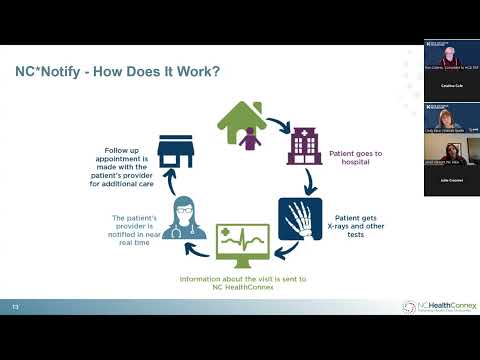
Janelle Stewart, assistant director for health analytics and external services at the North Carolina Health Information Exchange, described NC HealthConnex as the state’s mandated health information exchange and said the system supports a notification service called NC Notify that alerts subscribed care teams after admit/discharge/transfer (ADT) events.
“and our state has legislation that requires providers to connect to us, if they receive any state funds,” Stewart said, explaining that the statutory requirement applies to organizations serving Medicaid beneficiaries, state employees and other state‑funded programs. Stewart said the exchange connects all acute care hospitals and more than 10,000 ambulatory facilities, and that many large participants have chosen a full participation agreement to access services like NC Notify.
Stewart outlined two subscription tiers: a base tier that delivers standard ADT notifications via SFTP or bulk feeds, and a plus tier that provides a user interface with additional, enhanced alerts. On funding, she said North Carolina’s HIE is supported primarily through state appropriations and federal matching funds tied to state health programs; the exchange currently does not charge providers for core services. Stewart also told listeners she did not have an exact percentage for how many providers use full versus limited participation but said “more than 90 percent” of the state’s Medicaid patients are represented in their clinical data.
The presentation concluded with audience questions about duplicate events and deduplication efforts (Stewart said NC HealthConnex reduces noise before alerts are issued but cannot guarantee complete elimination of duplicates), and clarifications that subscriptions are patient‑panel specific and may be held by entire care teams or organizations, not just individual clinicians.