Get Full Government Meeting Transcripts, Videos, & Alerts Forever!
Get email alerts on the Resilience topic
No spam. Unsubscribe anytime.
Trane outlines hardened feeds and island-mode limits: hospitals and critical facilities prioritized
Summary
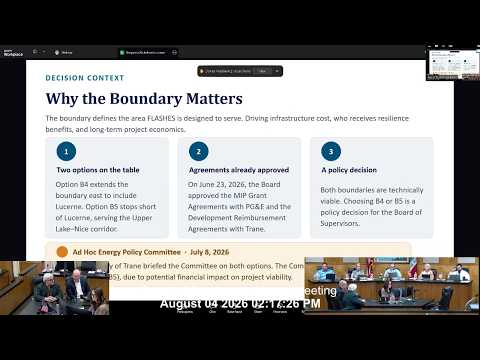
Trane described how hardened, underground feeds and automatic transfer switches would be routed to key facilities and said the smaller boundary would provide more island-mode hours—critical for hospital resiliency—while noting some winter limitations on solar recharge.
In its briefing to the board, Trane explained the design approach for resilience: hardened auxiliary feeds and automatic transfer switches would provide direct, protected power to a set of critical facilities including the Northwest wastewater treatment plant, the county jail, the emergency operations center, the sheriff's dispatch, and Sutter Lakeside Hospital.
Michael Day said the project aims to meet a grant condition that the microgrid be able to operate at least 24 hours in any month and described seasonal limits on solar recharge: 'in the middle of winter... we won't have enough energy from the PV to do a full recharge,' requiring grid top-offs in some conditions; but during summer months both systems could run for 'greater than 4 days' because of abundant solar. The smaller B5 boundary was described as producing more island-mode hours, particularly in winter, than the larger B4 footprint.
Staff said hardened undergrounded cables and dedicated feeds would be used for critical facilities and that the design would include automatic transfer switches to enable seamless switching during outages. Those resilience features shaped board members' interest in balancing coverage with workable project economics.