Get Full Government Meeting Transcripts, Videos, & Alerts Forever!
Get email alerts on the Land Use And Environment topic
No spam. Unsubscribe anytime.
Council declines to find expansion would endanger public health; Western Paving may proceed under state law
Summary
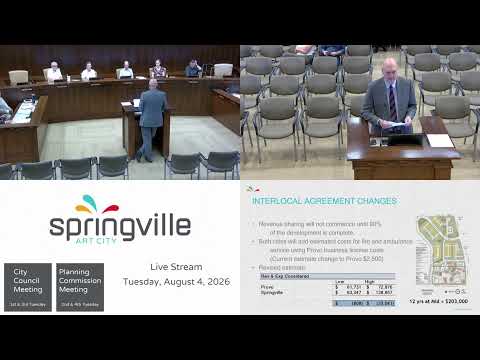
After a public hearing on a proposed expansion by Western Paving, the Springville City Council declined to make the required finding by a preponderance of evidence that the expansion would endanger public health, safety or welfare, meaning the company may expand under a 2025 Utah law unless enforcement action under existing city code is later upheld in court.
The Springville City Council held a public hearing on a proposed expansion of a vested critical-infrastructure materials operation owned by Western Paving Inc. and, after hearing presentations and resident testimony, did not vote to find by a preponderance of evidence that the expansion would endanger public health, safety or welfare.
Carla, a city staff member leading the presentation on state law and procedure, told the council that a 2025 Utah statute vests certain aggregate-processing uses and allows owners who held contiguous property before May 7, 2025, to notify the city and expand. She said the council can only stop an expansion if it finds, on the record, by a preponderance of evidence that the proposed expansion would endanger the public health, safety or welfare — and that any mitigation the council imposes during a subsequent 90-day period cannot exceed requirements of state permits ("they have to be reasonable and not exceed requirements imposed by permits issued by a state agency," S5).
Dan Sumption, who identified himself as the owner of Western Paving, described the company's long-standing presence in Springville and said crushing is an intermittent byproduct of their concrete and demolition work that they currently subcontract to Geneva Rock on portable machines. Sumption said moving stockpiles and crushing to a lower portion of the property would reduce impacts on nearby residences and that the company uses watering and magnesium chloride on haul roads to limit dust.
Residents and nearby landowners offered mixed testimony. Tim Parker, who said he lives immediately adjacent to the property, presented videos he said show recurring dust plumes and called for stricter mitigation or suspension of crushing activities. Parker told the council he had "10, 15 videos" and said on multiple days he recorded visible plumes and that piles exceeded code height limits. By contrast, several neighbors including Caroline Collette and Wes Crandall said they had not experienced persistent dust or noise problems and described Western Paving as a cooperative neighbor.
Sam Bernard, a consultant speaking for the company, told the council the site's SWIP (stormwater) documentation and air-quality permit appear current and that, from a regulatory perspective, the facility would be in compliance if inspected by the Utah Division of Air Quality. He also disputed one staff numerical claim and clarified the technical threshold discussed earlier during Carlas presentation.
Council members questioned how to evaluate competing evidence, including resident videos, staff summaries of two recent code complaints (one from 2023, closed after remediation; and a July 23 complaint still under investigation) and the states permitted "opacity" and emission thresholds. Staff explained that local code prohibits dust leaving the property but that mitigation tied to an expansion may not exceed limits set by state permits; the councils stated position was that city ordinances remain enforceable even if the site expands.
When the mayor asked for a motion to find a preponderance of evidence that the expansion would endanger public health, safety or welfare, no council member made that motion. The absence of a favorable motion meant the council took no action that would block expansion under the state statute. John, a city staff member, explained the practical result: unless the council documents and sustains violations under the city's existing ordinances (and, if contested, proves them in court), the operator retains the statutory right to expand onto eligible contiguous property.
The council left open the city's ability to enforce its dust and nuisance ordinances going forward, and staff said the city could still pursue code enforcement and court remedies if evidence shows violations of local requirements. The hearing record will be retained if the operator later submits an operating plan and the council determines mitigation is needed within the statutory 90-day window.
What happens next: Western Paving may submit an operating plan at any time; if the council later finds by a preponderance of evidence that expansion would endanger the public, the statutorily allowed 90-day mitigation process would be triggered. If not, the expansion may proceed under state law while the city continues to enforce existing ordinances.