Get Full Government Meeting Transcripts, Videos, & Alerts Forever!
Get email alerts on the Battery Energy Storage topic
No spam. Unsubscribe anytime.
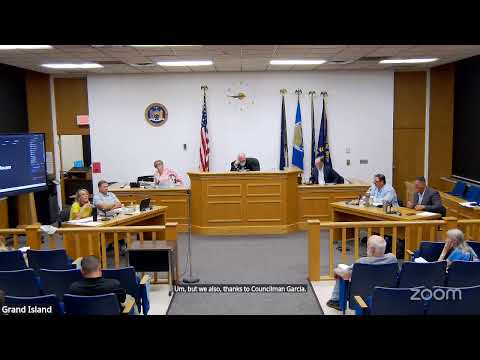
Grand Island board advances battery energy storage law after detailed public debate
Summary
After extended public comment, the Town Board adopted SEQR negative declaration and LWRP consistency findings for Local Law No. 5 (battery energy storage systems), moving the draft law forward while residents urged clearer tier definitions and more fire-department involvement.
The Town Board voted to adopt Parts 2 and 3 of the Environmental Assessment Form and a negative declaration for Local Law No. 5 of 2025, the proposed battery energy storage systems (BES) law, after extended public comment and internal discussion.
Resident Kristen Cascio delivered a detailed public critique urging the board to slow the process and strengthen the draft. She said the draft "does not even define a large scale or utility grade BES," argued the law is longer and more convoluted than comparable town codes, and flagged safety and permitting gaps, including what she characterized as the absence of meaningful Grand Island Fire Company involvement. In support of the law, Lauren Hall of Carson Power told the board, "I'm here to give my support for the law," thanking members for their work on the draft.
Board members reviewed planning materials and correspondence and debated adopting findings required under SEQR and LWRP. The board moved to adopt the negative declaration as written and to adopt LWRP consistency findings; both motions were seconded and carried by roll call. One board member asked for clarity on project tiers and permitting forms that Cascio had requested be made public; the record shows Cascio asked to see the permit referenced in the law.
Why it matters: the negative declaration and the LWRP consistency findings clear procedural hurdles that allow the town to proceed toward formal adoption, but public speakers and at least one board member urged additional clarifications on tier definitions, permitting language, and explicit fire-department roles before enactment.
What comes next: the board has advanced the ordinance through SEQR and related consistency findings; subsequent steps will be the final local law readings and any further revisions the board votes to accept.