Get Full Government Meeting Transcripts, Videos, & Alerts Forever!
Get email alerts on the Measurement topic
No spam. Unsubscribe anytime.
Auditors: program purpose and outcomes are unclear, making water‑quality effects hard to measure
Summary
OLA told commissioners that the Minnesota program's statutory purpose is not well defined, complicating selection of outcome metrics; auditors suggested clearer statutory goals and selective monitoring to demonstrate environmental impact.
The Office of the Legislative Auditor told the Legislative Audit Commission that the Minnesota Agricultural Water Quality Certification Program's statutory purpose is unclear, which complicates selecting outcome measures that would show whether the program improves water quality.
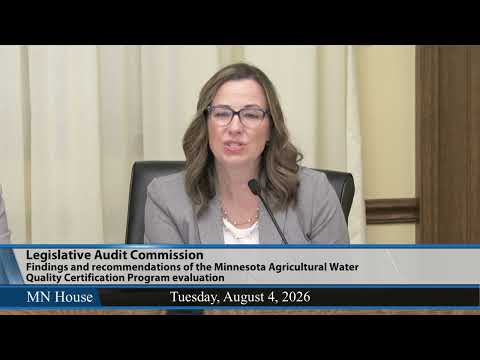
"The statutory purpose of the program is unclear," Caitlin Zenoni Wells said, explaining that potential purposes range from recognizing producers to reducing pollutants. She added that because the purpose is not well defined, identifying appropriate outcome measures is challenging and the program's reported outcomes (number of certified producers, new practices, and estimated pollutant reductions) do not necessarily capture the program's effect on water quality.
The auditors also flagged limitations in MDA's pollution‑reduction estimates: certifiers do not always record accurate implementation dates and the program does not collect water‑quality monitoring data such as edge‑of‑field or tile line tests. The report recommends the legislature clarify program purpose and that MDA consider targeted monitoring for a sample of certified producers to test modeled estimates against observed results.