Get Full Government Meeting Transcripts, Videos, & Alerts Forever!
Get email alerts on the Renewable Energy topic
No spam. Unsubscribe anytime.
UW–Madison Extension presents renewable energy siting guidance to Vernon County board
Summary
UW–Madison Extension presented a RESET report advising Vernon County on large-scale wind and solar siting, local permitting tools and community concerns, noting no large projects are currently proposed and stressing early planning, ordinances and lease protections for landowners.
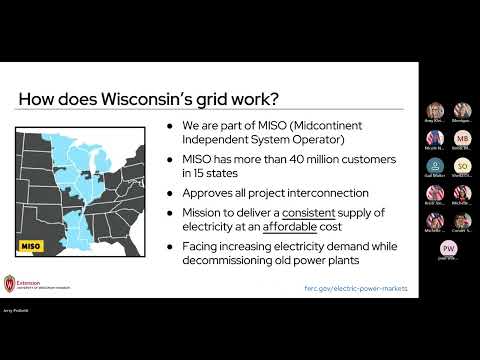
Jesse Bradish, from UW–Madison Extension, presented the RESET (Renewable Energy Siting and Engagement for Tomorrow) report to the Vernon County Board, summarizing community engagement, technical background and options for local regulation. Bradish said the work was funded by a Department of Energy grant and consisted of seven engagements that produced more than 200 community comments and a 70‑page report of findings and model ordinances.
Bradish told the board that "we could do 0.333 of all of Wisconsin's electricity needs using less than 3% of our current field cropland," and that the county should prepare for proposals even if none are pending. He outlined permitting thresholds and review: projects under roughly 100 megawatts (about 700 acres) are often handled at the local level, while larger projects typically go to the Public Service Commission. Bradish emphasized lease‑agreement review, developer contact information, and negotiating decommissioning and stormwater plans into contracts so costs do not fall to landowners or the county.
Board members raised questions about agrivoltaics, grazing, recycling and decommissioning. Bradish said agrivoltaic pilots exist but retrofitting designs to accommodate cattle is often cost‑prohibitive; he urged that counties include stormwater and decommissioning requirements in permitting or zoning documents and work with DNR stormwater specialists. He also suggested counties consider permitting ordinances where they lack zoning authority, and offered model language and slide resources (go.wisc.edu/solarordinance) for local use.
The presentation closed with Bradish offering follow‑up materials and one‑on‑one conversations for landowners and local officials.