Get Full Government Meeting Transcripts, Videos, & Alerts Forever!
Get email alerts on the Watershed Permit 408 Park St topic
No spam. Unsubscribe anytime.
Belmont watershed administrator presents permit for 408 Park Street; engineer says pond retrofit will handle added runoff
Summary
Belmont City engineer Kate Givens presented a watershed protection permit for 408 Park Street, saying a retrofit to an existing pond and a maintenance agreement would treat added runoff after the site’s impervious area would rise to about 26.8% (above the 24% threshold). The board moved to approve the permit as presented; the transcript does not show a recorded vote tally.
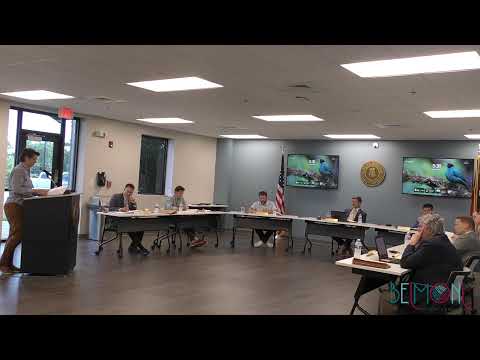
Kate Givens, the Belmont City engineer and watershed administrator, told the Watershed Review Board she is presenting a watershed protection permit application for 408 Park Street.
"Kate Givens, city engineer, also a watershed administrator," she said, and then described the site and proposed changes. Givens said the parcel is about 8.662 acres and currently about 22% impervious; the planned parking and outdoor storage expansion would raise imperviousness to about 26.8%, exceeding the board’s 24% threshold that triggers a high-density permit for properties in the protected watershed.
Givens described the existing stormwater pond, built in 2002, and a planned retrofit to capture the additional impervious area. She said the retrofit would provide water-quality treatment for the 1-inch storm and would detain the 1-year and 10-year storm events in accordance with local watershed ordinance requirements. "It will also detain the 1 year and the 10 year rain events, which is these are ordinance," she told the board.
She explained permit conditions that will be required for approval: an operational maintenance agreement obligating yearly inspections and cleaning to ensure the pond functions, and a bond tied to construction cost and maintenance. "That cost is listed on the permit, $75,000," Givens said. The application packet also includes drafts of the maintenance agreement and the construction documents; an easement will be recorded around the pond because one was not already on record.
During questions, a board member asked whether the pond retrofit as proposed will be adequate for the added runoff. Givens said she reviewed the hydrologic calculations and confirmed the design: "It is a wet pond, so it will hold water all the time. It has, like, permanent pool element to it." She added the pond will be fenced for safety and that if a future Phase 2 expansion occurs on the west side of the site the owner may need to add another pond and submit amended watershed permits.
After discussion the chair moved to approve the permit as presented and a second was recorded. The transcript segments provided record the motion and second but do not contain a formal recorded vote tally in the supplied text. The application materials in the packet—operation-and-maintenance drafts, bond language and the recorded-easement requirement—remain conditions to be completed as part of final approval and recordation.