Get Full Government Meeting Transcripts, Videos, & Alerts Forever!
Get email alerts on the Surveillance topic
No spam. Unsubscribe anytime.
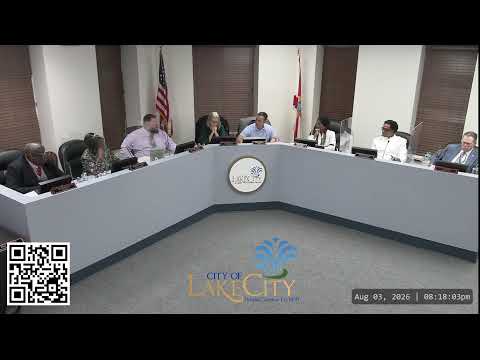
Lake City council declines to place nonbinding referendum on automatic plate-readers after heated debate
Summary
Councilman Carter proposed a nonbinding November ballot question on automatic license-plate readers and vehicle-data cameras; after extensive public comment and a split council debate weighing privacy and safety, the council voted 3–2 against placing the referendum on the ballot.
Councilman Carter introduced a resolution asking city staff to place a nonbinding question on the Nov. 3, 2026 ballot asking whether the city or its contractors should continue installation and maintenance of automatic license-plate readers and cameras that collect and store license-plate and other vehicular data.
Carter framed the measure as a way to let voters decide where Lake City should land on a divisive surveillance question. “This is a small, practical way to check the temperature of the community,” he told the council, arguing the question would cost little because it would be added to an already scheduled election. Supporters and opponents said the item raised constitutional and practical issues.
Multiple residents urged caution or opposed the systems outright. Public commenter Eric Tober warned of continuous surveillance and likened an unchecked system to the kind of “society” described in dystopian novels, saying it would be “a dangerous thing” if unchecked. Sylvester Warren asked why the community had not been consulted earlier and urged the council to consider 4th Amendment protections before expanding surveillance.
Supporters, including Vice Mayor Young and several public speakers, said the system has helped solve violent crimes and child-abduction cases. Chief Butler told the council the city’s ALPR deployment had been in place for roughly four to five years and credited the system with identifying suspects in homicides, attempted murders and other violent cases. “We have used that feature in order to try and identify the vehicles,” he said, adding the system captures vehicle imagery and license plates, not the driver’s face, and that the department requires a case number and dual authentication for access.
Legal and technical concerns also surfaced. Resident David Nobles and others told the council that when systems are networked across jurisdictions and private partners they may create continuous location records that implicate the Supreme Court’s Carpenter decision on historical-location privacy. Nobles also warned that private storage arrangements can shift legal and financial liability to municipalities in litigation.
Council debate was terse but divided. Carter argued a ballot question would let voters decide without immediately changing policy; Councilman Jernigan and Councilwoman Harris said they were not yet convinced a referendum was necessary. On the roll call vote the motion to place a nonbinding referendum on the ballot received two votes in favor (Councilman Carter and Mayor Walker) and three opposed (Vice Mayor Young, Councilman Jernigan and Councilwoman Harris), so the council did not advance the referendum.
Outcome and next steps: The council did not adopt the nonbinding referendum resolution. Councilmembers who favored public input said they may revisit the issue if new information or court rulings emerge. The police chief and staff said they would continue to follow statutory and judicial guidance on ALPR use and data access.