Get Full Government Meeting Transcripts, Videos, & Alerts Forever!
Get email alerts on the Impervious Area Policy topic
No spam. Unsubscribe anytime.
Arlington staff outline options to cap impervious area in low‑density neighborhoods
Summary
County planners presented a hybrid proposal to limit hard surfaces in R‑zoned neighborhoods aimed at protecting stormwater uptake and tree canopy while preserving allowances for undersized lots; staff sought public feedback through fall engagement.
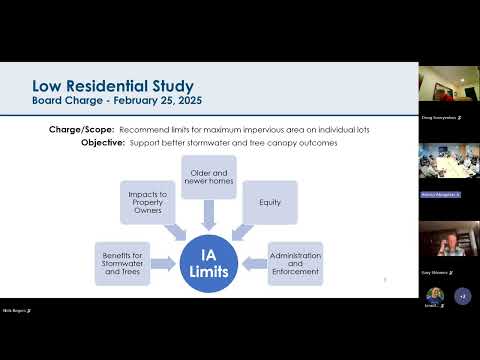
Nick Rogers, principal planner with Arlington County’s Department of Community Planning, Housing and Development, told the Natural Resources Joint Advisory Group on Aug. 3 that staff is recommending the Board consider impervious‑area limits for low‑density residential districts as a clearer way to protect tree canopy and manage stormwater.
"Main building footprint is simply the amount of area that a building, along with things that are attached to it, can cover on an individual residential lot," Rogers said, using that definition to explain why a policy based on total impervious area (roofs, driveways, patios and similar surfaces) differs from existing lot‑coverage rules. He emphasized the study’s focus on a hybrid approach that treats undersized, standard and oversized lots differently rather than applying a single percentage across Arlington.
Staff presented data from the county’s 2024 stormwater utility GIS layer and peer benchmarking that show newer development generally has larger footprints and higher impervious coverage. Rogers said staff developed lower, middle and upper percentage options by zoning district and created illustrative "test‑fit" diagrams, posted on the study website, so property owners can see how each option would affect a particular lot.
The presentation stressed tradeoffs: stricter caps produce better environmental outcomes but increase the number of nonconforming properties, while higher caps preserve property‑owner flexibility at the expense of tree canopy and stormwater benefits. Staff said it will use phase‑2 public feedback and a Board work session to refine a recommendation for potential zoning text in phase 3.